
Buying an electric vehicle
I had questions, you had questions
I bought a Rivian R1T Adventure!
It’s an electric pick-up truck with a large battery!
I’ve had it for just over a week as I write this post. I really like it so far. I’ve learned so much in the process of buying an electric vehicle (EV). I personally had so many questions before the purchase, and so many people have me asked questions since.
This post is meant to organize my thoughts for easy access to information, for anyone considering an EV.
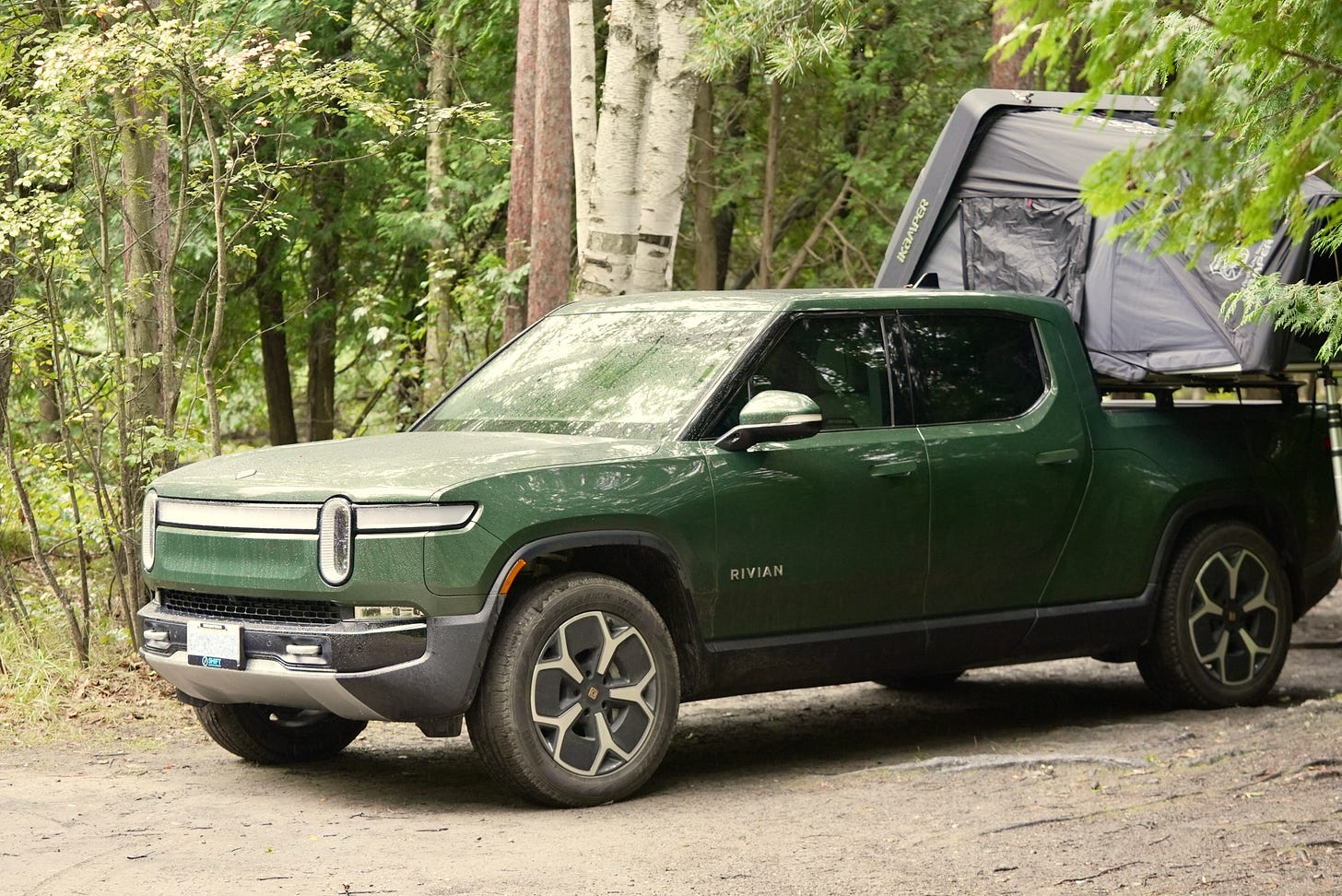 *I went camping on Sunday at The Pinery, an Ontario Provincial Park, to test out my camping setup – I bought an iKamper Sky Camp Mini 3.0 hardshell roof top tent for my cross country trip.*
I also want to share this as there is a lot of misinformation around EVs – online, at dealerships, at dinner tables. This is partly because the vehicles available and charging infrastructure has changed a lot in the last few years, and partly because dealerships are disincentivized to sell EVs. Having that, almost every automaker has great EVs now (there is a list at the end of this post).
This is a very long post. The short version is that today, EVs are a great choice for most people – if you have the budget for one. As long as this post is, EVs are quite simple to own and drive.
Why are there so many kinds of electric vehicles now?
When you are shopping for an EV, there are many confusing terms as traditional automakers are trying to market internal combustion engine (ICE) vehicles as EVs.
The following types of vehicles use only electricity to drive the vehicle:
- BEV: Battery Electric Vehicle. This is what you think of when you hear EV. These are pure electric vehicles like Rivian and Tesla, the Ford Mustang Mach-E, Volkswagen id.4, Hyundai Ioniq, etc. Most new BEVs with extended range batteries have ~500km (300 miles) of range on a full charge. You can recharge at EV charging stations or at home. The entire thing is electric, there is no gas. BEVs have the largest Federal rebates available. This post is going to focus mostly on BEVs.
The following types of vehicles are gas vehicles with supplemental electric motors and batteries, and only some types of these vehicles can use electricity to drive the car for a limited range. Because these vehicles have gas engines, they require all of the maintenance of ICE vehicles (like oil changes and buying gas).
- PHEV: Plug-In Hybrid Electric Vehicle. These vehicles have a small electric motor and battery, usually providing 20–40km of pure electric range, and then a gas engine that drives like a typical car. You can recharge at EV charging stations or at home. When the battery runs out it switches to a gas engine, which you can fill up at any gas station. You basically have two cars in one. These are for people who mostly drive in the city and can’t move past their range anxiety for longer trips. PHEVs have smaller Federal rebates available.
- Hybrid: Hybrids, like the Toyota Prius, also have a small electric motor and battery. This battery is even smaller than in a PHEV, and its main goal is to support the engine – boosting power and torque, and at city driving speeds it can power the vehicle with only electricity. The battery also supplies power to heating, cooling, and infotainment systems to increase fuel efficiency. Since the battery is small, it is only charged by regenerative braking – you can’t plug it in. This is old technology, the first Prius came out in 1997!
- MHEV: Mild Hybrid Electric Vehicle. These have an even smaller battery and motor, powered by regenerative braking. MHEVs use regenerative braking to create electricity that takes the full load off the engine, increasing fuel efficiency, but you can’t drive in an all electric mode. This is purely a marketing term and in my opinion these really shouldn’t be branded as EVs. They are much more fuel efficient, I rented a Volvo XC90 Mild Hybrid in April and got 800km of range with a 40L tank of gas. But at the end of the day, it’s a more efficient gas vehicle.
Only BEVs and PHEVs are eligible for the Canadian Federal iZEV rebate program. The rebate takes $2,500 (PHEV) to $5,000 (BEV) from the after-tax cost of an EV at the point of sale (you save the money at the dealership, not your tax return). You can view eligible vehicles here. Some Provinces also have additional incentives for BEVs (not Ontario).
Before diving any further in, a note on terminology below: when I refer ICE vehicles – internal combustion engine – I am referring to regular gas cars, SUVs, trucks, etc. When I refer to EVs after this point, I specifically mean Battery Electric Vehicles, as the hybrid options (PHEV, Hybrid, MHEV) do not share all the same features/benefits, and retain the same downsides as an ICE vehicle.
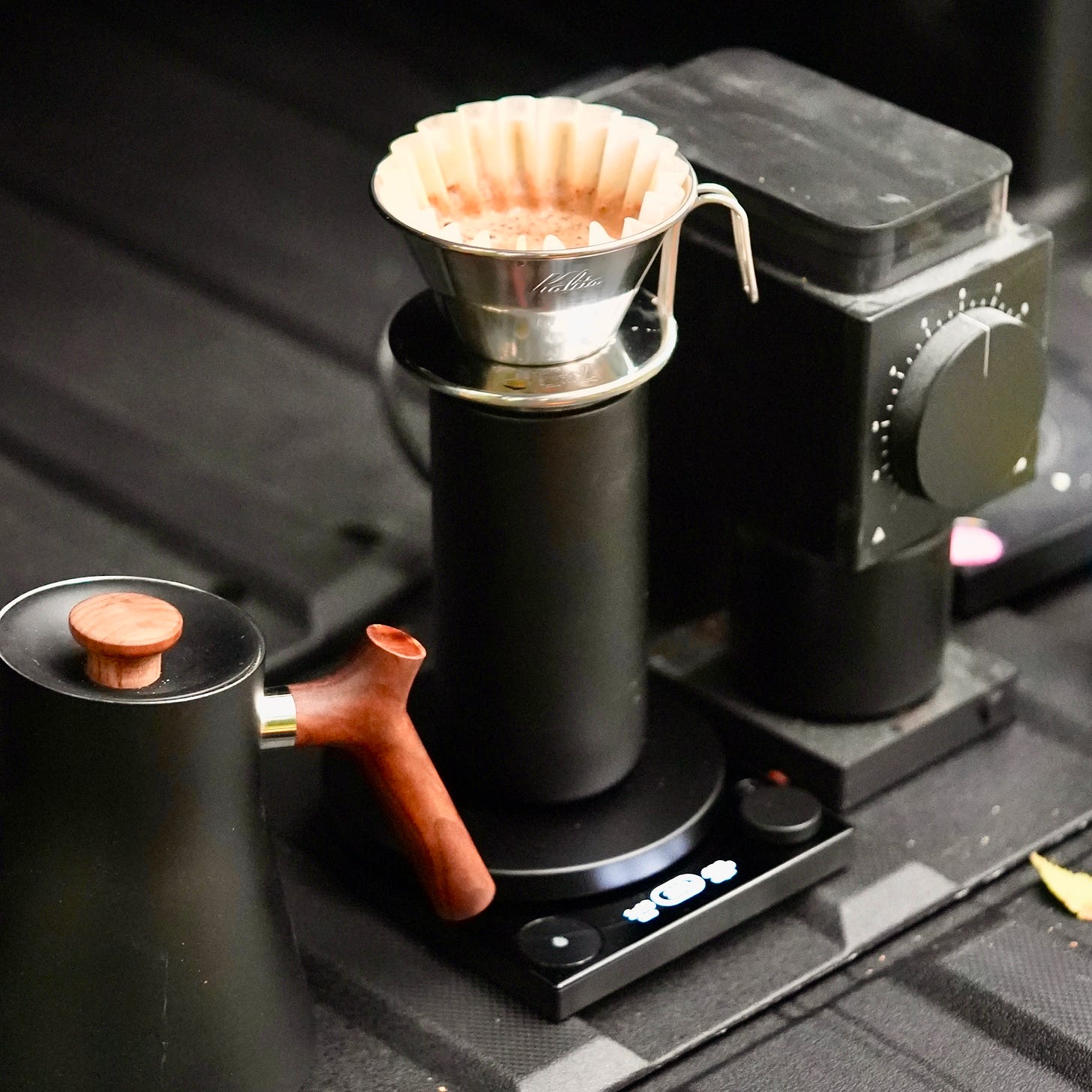 *While I was on my test camp, I powered my electric coffee grinder and electric kettle with the 120V/15A outlet in the truck bed to make pour over coffee in the morning. While I’m on my cross-country trip I am going to have two induction burners, a combi-steam oven, and more powered by the truck! The magic of driving a giant battery!*
Why buy an EV?
There are many pros to buying an EV.
- BEVs are nearly silent to drive, it’s a much more calming driving experience than an internal combustion engine (ICE).
- BEVs are very fun to drive (even the lower cost ones) due to the way electric motors work. They zoom! They’re smooth!
- BEVs have fewer parts that can break. The entire vehicle is a battery, one or more electric motors, two axles, an HVAC system, and many computers. There are ~20 moving components in an EV that can break and over 2,000 in an ICE vehicle.
- BEVs have almost zero maintenance costs. You have to change your air filter and maintain your tires/brakes. That’s it. ICE vehicles need regular maintenance, like oil changes. BEVs don’t need oil.
- Daily operating costs for a BEV are far lower than the cost of operating an ICE vehicle. To drive 100km, it will cost you ~$0.20 with EV if you charge at home, ~$2.00 if you charge at a commercial charger. A relatively efficient ICE vehicle will cost ~$15 if regular gas to drive 100km (at 8L/100km performance).
- Car insurance is cheaper for EVs (green vehicle discounts).
- EVs with Green license plates can use the HOV lane in Ontario with only one occupant (your State/Province might vary).
-
EVs have a ton of bonus perks since they are giant batteries:
- Some EVs have 15A electrical outlets (the same as in your home), so you can plug things into it – like an induction cooktop, electric kettle, and a countertop oven, or use power tools.
- Some EVs have “Camp Mode” where the HVAC system will stay on overnight if you camp inside the vehicle.
- Today, vehicles like the Ford F150 Lightning (and, allegedly soon for Rivian) have Vehicle-to-Home Power. This means during a blackout, your vehicle’s battery can power your house. Depending on your battery size and how much power you use, this could power a single family home for over a week – great if you live in places prone to storms or unstable energy grids.
- In the apocalypse you can power your car with a solar panel instead of siphoning expired gas while the zombies are coming for you! And with 0–60 in 3.5 seconds, you’ll get out of the zombies path fast!
Why not buy an EV?
- Price: Generally, you won’t get a new EV below $50,000 Canadian. You might with stacked rebates or buying used. If you compare 5-year ownership costs, EVs can be lower cost than comparable vehicles, but the upfront cost comparison isn’t great and there needs to be many more options at the low end price point.
- Range / infrastructure anxiety: Once you do the research on EVs, I think most people will be able to move past this. I’ll address my own anxieties/questions about this in detail below. I am doing a cross country road trip to national parks – very off grid – and I’ve been able to make a plan that is realistic using an EV.
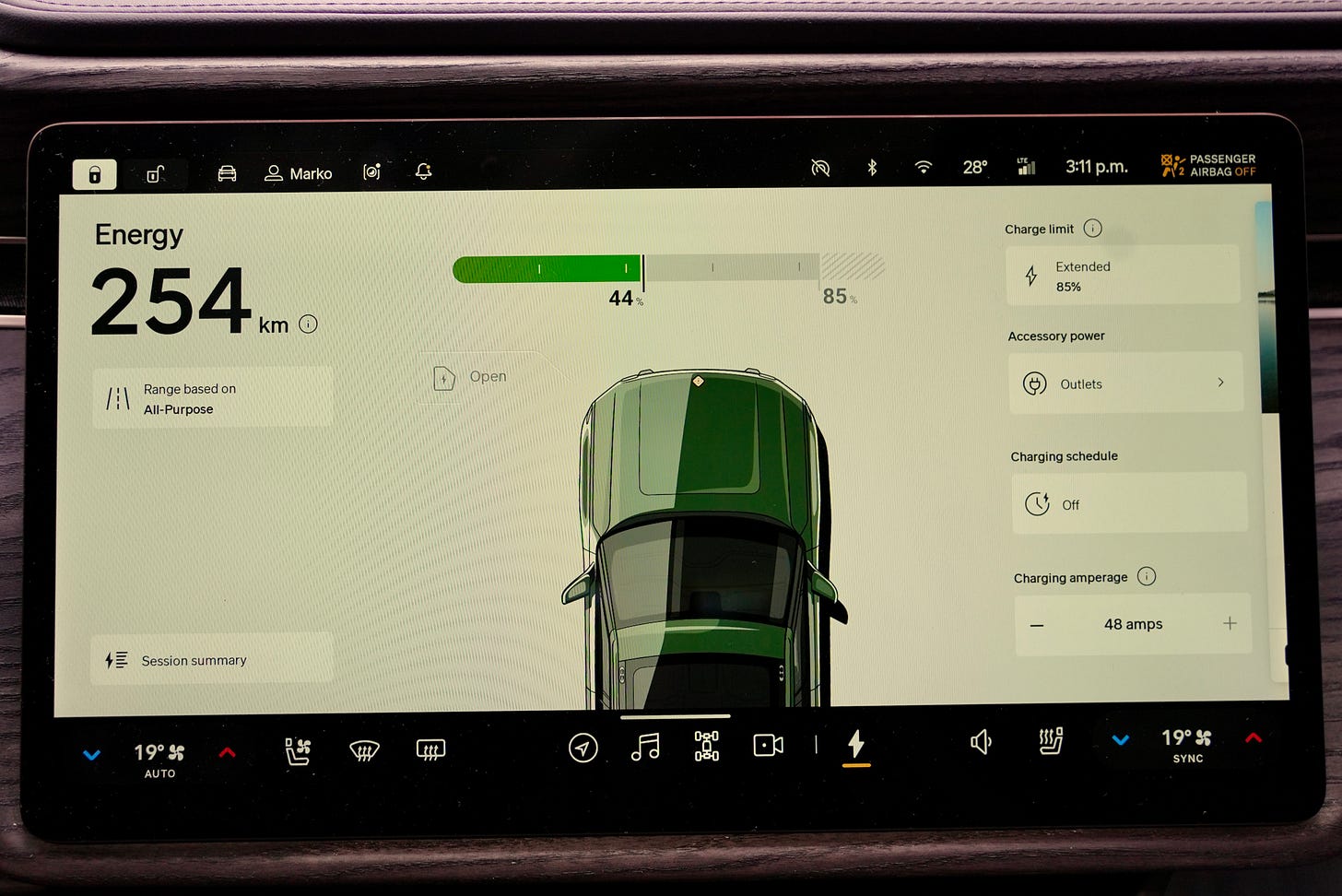 *My Rivian R1T Adventure with Large battery appears to get well over 550km of range. With less than 50% charge I can still go to Toronto and back!*
How far can you drive in an EV?
It depends on the vehicle you get. Most of the vehicles I evaluated have ~500km range when buying the long range battery upgrade. This includes:
- Rivian R1T (which I bought) and R1S, both of which have a Max battery option with a > 650km rated range
- Volkswagen id.4
- Ford Mustang Mach-E
- Nissan Ariya
- All the BEV models from Tesla, Kia, Hyundai, BMW, and Volvo
500km range is a lot. It’s enough to drive from Kitchener to Ottawa (489km) without stopping. Or to Toronto and back twice (220km roundtrip) without charging. Even in freezing weather, where the range can drop by 15%, you would still have a total range of 425km with a full charge.
I’m not sure who is driving more than 400km (4 hours) at a time without stopping to pee, eat, and stretch their legs. During that time you can fast charge the vehicle in 15–20 minutes. Generally, most people only drive that far on holidays/road trips. If you drive less than 100km/day, you can easily keep your charge with a standard home electric outlet and use fast chargers on road trips.
Traffic jams are a concern I’ve heard a lot, but EVs don’t lose much range while idling.
If you are stuck in traffic for hours, the electric motors will turn off, but you still have access to climate control, music, USB-C ports, etc. At most you’ll lose 1% or 2% of range after several hours. This is a huge benefit if you’re regularly stuck in traffic. By comparison, an ICE vehicle is always burning fuel – costing you money and running the risk of running out of gas – every time you’re in a traffic jam.
Can I really make it to a remote destination?
A friend of mine recently shared that she would love an EV, but they have a remote cabin they go to a few times in the summer. Could it possibly work for them, or should they get a PHEV?
For longer road trips and remote destinations, such as my upcoming cross-country trip, tools like A Better Route Planner can help you plan your charging stops. It’s free. If you want to see what your own road trips would look like, plug your trip in and see what it says. I recommend round-trip planning to make sure you can have enough charge to get home. You can even select the vehicles you’re evaluating, and whether you have access to Tesla Superchargers or not, and see how the route changes.
I was very stressed about planning my road trip with an EV until I did the math.
In 2020 I drove to Thunder Bay, the Canada way, in my old Volvo XC40. I remember seeing a sign that said last fuel stop for 300km! The stress that caused me! I plugged that same drive into A Better Route Planner and saw that there are chargers all along that drive. Now I’m only stressed about being eaten by a bear (1 in 22.4 million odds, yet still scarier than running out of battery).
You’ll quickly learn that there are very few places you can’t get to with 500km of range.
 This is the route to Thunder Bay, a very remote drive that’s uncomfortable even in a gas car.
You can see the EV route takes longer “on paper” (19 hours vs 15 hours for the same route in a gas car) – but I don’t know who is driving 1,472km without stopping for breakfast, lunch, and dinner (at least twice each because you probably need to sleep).
 If you make this drive, you’re probably going to stay at the Voyageur’s Lodge in Batachawana Bay, where I stayed there in 2020. You’ll get the apple fritters. They have a Tesla Destination Charger to charge your vehicle while you sleep, and when you wake up rested with your car fully charged, you can eat donuts I’ve been thinking about for 4 years.
Yes, they are on my route for this trip.
 I specifically bought an EV with Tesla Supercharger access because I wanted the infrastructure flexibility for long road trips. But, you can see here, it’s still a very realistic drive even without Tesla Supercharger access!
But is it really cheaper to operate?
Yes, substantially!
For the price comparison, I’m going to use the Volkswagen id.4 instead of my pickup truck. It’s an SUV, it’s a great vehicle for most people, and comparable to most other EVs on the market. It has an 82kW battery which provides roughly 500km of real-world range. It compares well to the Volkswagen Tiguan – a same size class ICE vehicle, by the same manufacturer, which has a 60L tank with roughly 600km of real-world range.
- Charge at home: $7.13 – Charging a VW id.4 at home using off-peak rates (plugged in overnight), for a 0% to 100% battery charge. (Source: Kitchener Hydro rates, Aug 2024)
- Commercial charging stations: $38.54 – DC Fast Charging at a Park+Charge would cost $38.54 for a 0% to 100% battery charge (~500km range). (Source: Park+Charge EV rates, Aug 19)
- Regular Gas: $96.60 – Fueling a VW Tiguan with regular gas would cost $96.60 for a 60L tank (~600km range). (Source: Shell, Aug 12)
- Premium Gas: $118.80 – Fueling a vehicle that needs premium fuel would cost $118.80 for a 60L tank. (Source: Shell, Aug 12)
The average Canadian drives 15,200km per year. That means:
- If you only charge at home, your energy costs are $216/year ($1,084 over 5 years)
- If you only charge at commercial DC Fast Chargers, your energy costs are $1,172/year ($5,858 over 5 years)
- If you only use regular gas, your costs are $2,447/year ($12,236 over 5 years)
- If you only use premium gas, your costs are $3,009/year ($15,048 over 5 years)
You also save the costs of vehicle maintenance:
- EVs don’t need oil changes – there is no oil
- EVs don’t have random fluids – only windshield wash – there is no transmission fluid, coolant, etc.
- EVs don’t have spark plugs – there is no engine to spark (EVs have motors)
- EVs have almost 2,000 fewer moving parts that can break compared to an ICE vehicle – there no belts! No gears! No cogs! (I don’t know what car parts are called, and neither do you! But they break!)
You can do the math to see what your savings would be.
I’m moving to Nova Scotia where the electricity rates are higher than Ontario – it’s the number one complaint people offer about the Province – and even there, overnight charging a Volkswagen id.4 at home would cost a whopping $9.41!
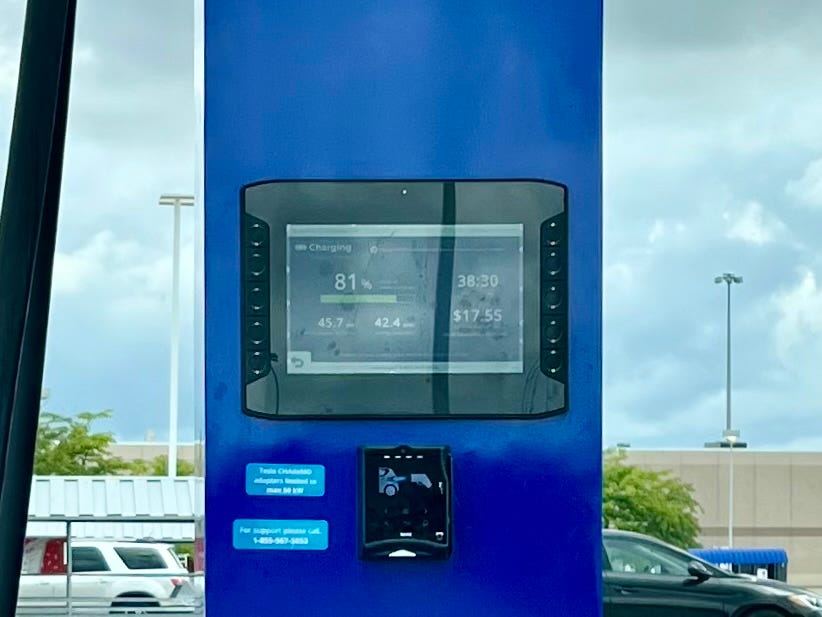 *My first time at a commercial charger wasn’t great. I did not get fast charging to work – you can see it’s charging at 42.4kW (not the promised 150kW of this station). I was still able to charge to over 80% for$17.55!This charging station is a bit of a scam that charges by the minute, where most others charge by the power delivered (in kW). At a Tesla Supercharger this takes 15 minutes.*
What’s the deal with EV charging?Where do you charge?How long does it take?Do I need to hire an electrician?
EV charging infrastructure is rapidly evolving right now and there is a learning curve that you can pick up in a week. The learning curve feels high because there are so many new words and terms here. But really, you just need to find a station near you and plug your vehicle in.
Since I just sold my house, I have not installed any sort of charger at home. I have a century home, so there isn’t a garage and I don’t have easily accessible outdoor outlets. This means I’m entirely reliant on commercial charging. If I was not moving I would install a charger in the driveway – they can be installed outdoors.
Most people will be fine charging at home most of the time
If you can charge at home, you will rarely have to think about EV charging, except for road trips. Depending how much you drive each day, you may not need a fast home charger. With a standard electrical outlet you can add up to 85km of range by charging overnight (8 hours).
Yes, you can plug an EV into a standard outlet. I tried this at my dad’s house, using an outlet in his garage.
You probably want an at-home fast charger. These need to be installed by an electrician, and require running new electrical lines, which adds to the upfront costs. Depending on the specs, an at-home fast charger can fully charge your battery in a few hours. Expect this to cost around $2,500 with installation (depending how far away your electrical panel is, the wire alone could be $700).
For faster charging, you can head to a 150–250kW DC fast charger, which can charge your battery in 15–30 minutes. These are usually at or near grocery stores, restaurants, coffee shops, or malls.
There are so many ports
EVs need to support both Direct Current (DC power) for fast charging, and Alternating Current (AC power) for home charging. This is important to know for how you evaluate charging stations, plugs, and adapters.
Today EV charging is a bit like smartphones in 2011. Does your phone have Mini USB? Micro USB? Lightning? Now everyone, even Apple, has a USB-C port on their phone (though some of us still have lightning ports). It’s like that.
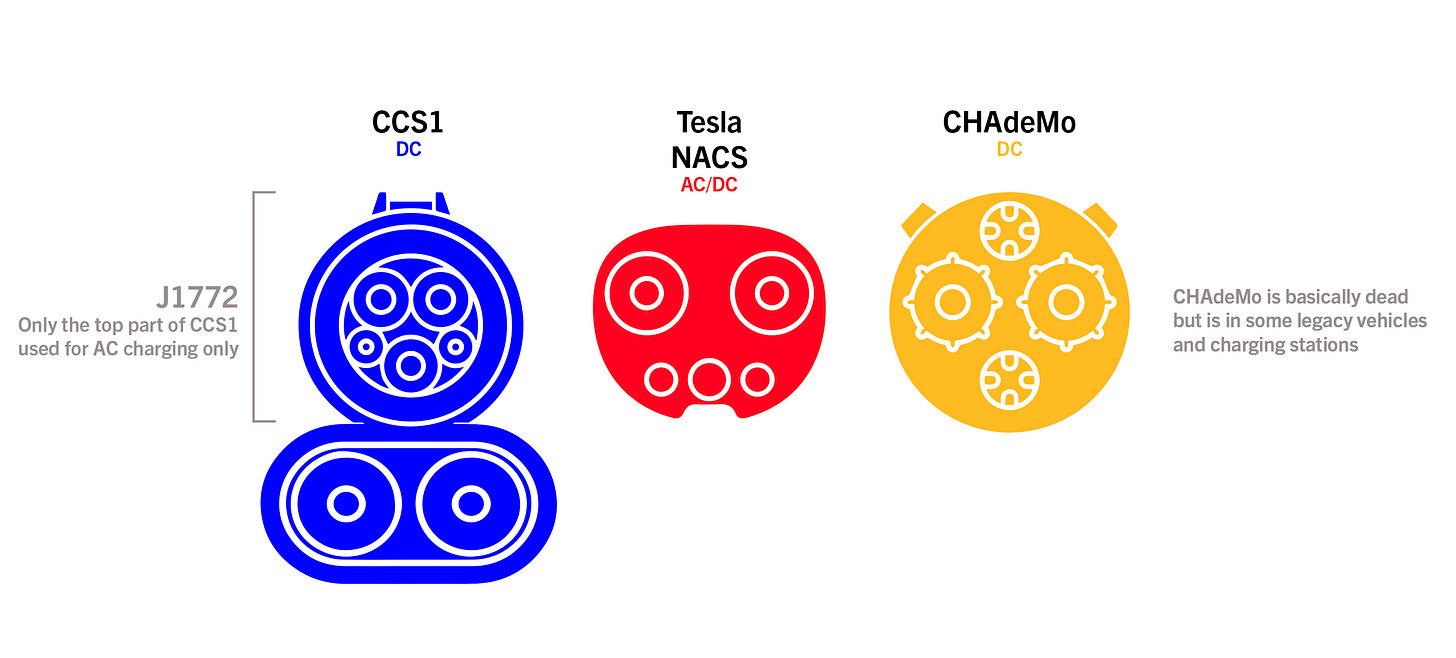 EV Charging is in the middle of resolving that mess. You will see the following types of charging ports:
- NACS (Tesla Supercharger) – This is the USB-C of EV charging. It’s the newly agreed upon North American Charging Standard for DC fast charging, designed by Tesla. Every manufacturer has agreed to move to NACS in North America. If you do not currently have a NACS vehicle, you can buy an adapter to convert from NACS → CSS. (Europe standardized on CCS1, and forced Tesla to adopt it).
- CCS1 – Most non-Tesla vehicles on the market today have CCS ports. Most non-Tesla commercial charging stations have CCS plugs. If you have a NACS vehicle, you can purchase a CCS → NACS adapter to use CCS chargers.
- J1772 – This is a smaller part of CCS, but for AC charging (home power). To use Tesla Destination Chargers you need a NACS → J1772 adapter.
- ChAdeMo – This was an early type of plug that has mostly been discontinued. You’ll see it on older models like the Nissan Leaf, and some charging stations. It’s important to know insofar as you’ll say “what’s that?!” at charging stations and on maps.
If you buy a non-Tesla vehicle today, it most likely has a CCS charger. You’ll want to purchase a NACS → CCS adapter. All of the automakers have agreed to move to NACS, which will begin happening in 2026 model years or later.
Yes it's all confusing to read, but you buy an adapter once and you’re fine.
Should I just wait for a NACS vehicle then?
If you buy a NACS vehicle you still need an adapter to use CCS charging stations. In either case you need an adapter. This is not a reason to wait. It’s going to be 10 years before everything is NACS.
What’s the deal with all these charging networks?
Commercial charging networks are growing. I’m surprised by how many there are. When you are looking for a charging station, you want to look at the following information, all of which you can see in maps.
- Speed – how fast can it charge your battery?
- Uptime – how reliable is the station?
- Availability – are there free stalls?
- Cost – some stations are free or discounted
Locally, I’ve been using Park+Charge at Laurentian Zehrs because it’s fast (150kW speed), nearby, and reliable. Once I get my NACS adapter, I will switch to using the Tesla Supercharger (250kW) because it’s closer and faster. I tried going to Circle K (200kW) on Victoria Street but the charging station was down. There are a lot of free chargers around that I haven’t explored yet, but most of them are slower.
Some vehicles integrate directly into some charging networks. At Tesla and Chargepoint, I can simply plug my vehicle in and it bills my credit card on file. Some stations require apps that ask for privacy invading access to your phone, like Circle K, which you should deny because a corporation has no right to your location 24/7. Some take payment at the terminal, and work like gas stations, like Park+Charge.
When you search for charging stations on maps, you can see the charging ports available, charging speed, and whether the station is currently occupied.
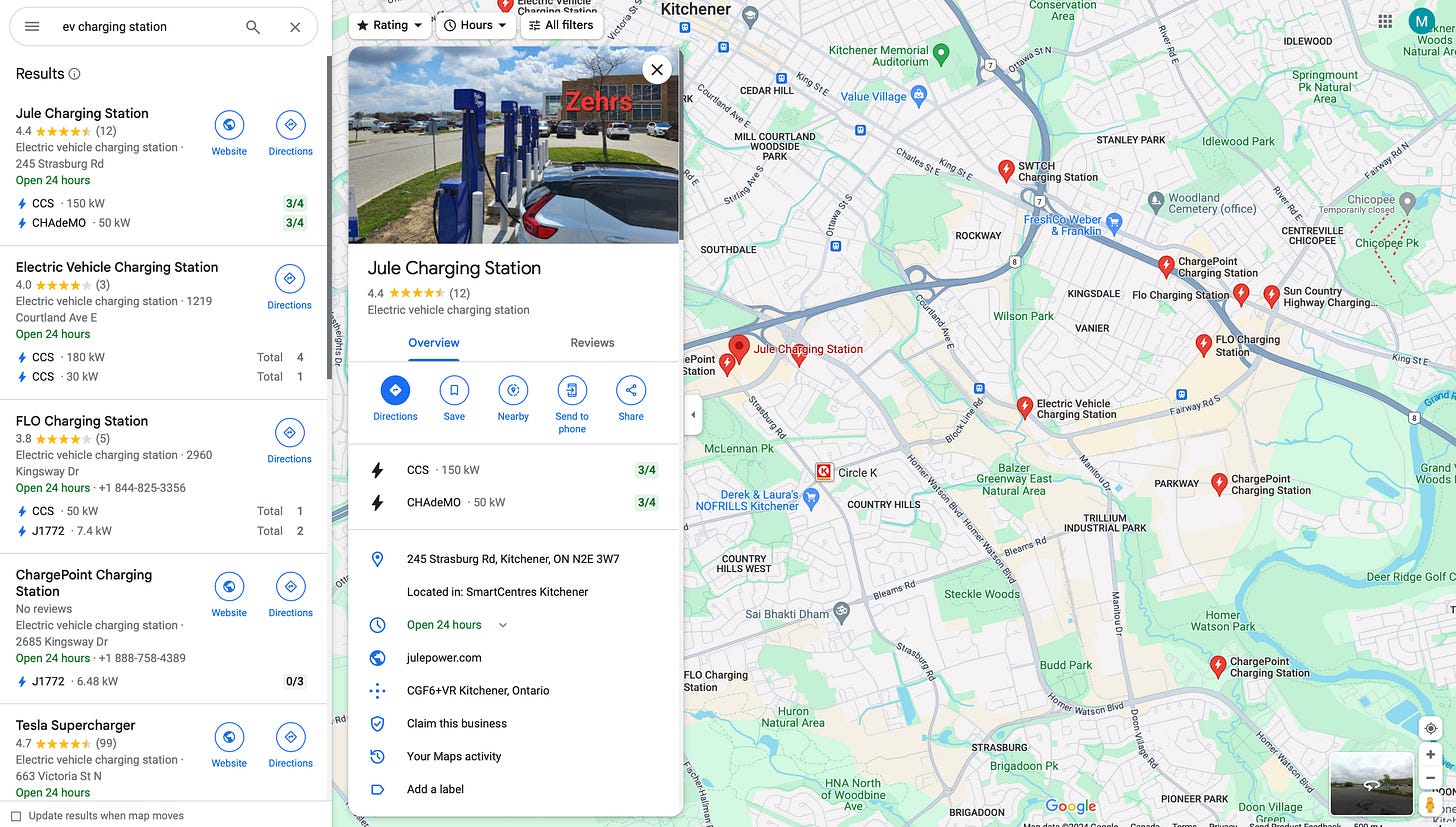 *You can see in the listing here that this charging station supports CCS at 150kW speed. This station also supports CHAdeMo.*
Can I use Tesla Superchargers with a non-Tesla?
Maybe!
Today, only Rivian and Ford are supported.
If you have a Tesla, Rivian, or Ford, yes – you can use Superchargers. Otherwise maybe? Sometime in the future? It depends on if Elon is happy long enough to not fire that team until they get the work done?
If you have a Supercharger compatible vehicle with a CCS port, you will need a NACS to CCS adapter.
There is a lot of misinformation out there around Tesla Superchargers, since many car dealerships don’t do any EV training with their sales staff. When I went to Nissan, they told me I just need to buy an adapter for $50 on Amazon and I can use the Tesla Superchargers.
This is factually wrong. (1) Superchargers will NOT work until each manufacturer is approved by Tesla, and (2) Cheap adapters are a recipe for a fire.
DC fast charging adapters need to handle 250kW – 50x more power than your oven uses, so it is not the place to be cheap.
UL ratings for EV adapters aren’t formalized yet, so you want to get one directly from your vehicle manufacturer until UL rated adapters are available (the adapters supplied by Ford and Rivian are in very limited supply since they are made by Tesla, and, well, Elon.
You can buy the A2Z Typhoon Pro adapter (I did). They claim it will meet the upcoming UL2252 standard once the standard is ratified, CE certification is in process, and FCC certification is obtained. It’s $295, and they’re a Canadian company. 4/5 strangers on the internet agree it’s the best option if you can’t get an adapter from your manufacturer.
A small note on my truck: since I bought a used vehicle, I can’t get a free adapter from Rivian. Rivian says I can buy one in their gear shop when they’re available. They are not available. They have no date for availability. And if they were available, the gear shop doesn’t even ship to Canada! Rivian is a relatively young American company, so I am accepting of these “early adopter” problems while they scale, but I will be vocal about them because they need to improve their operations if they want to succeed. If you buy from a traditional manufacturer, like Ford, you may still run into the same customer service issues because the adapters are on back order.
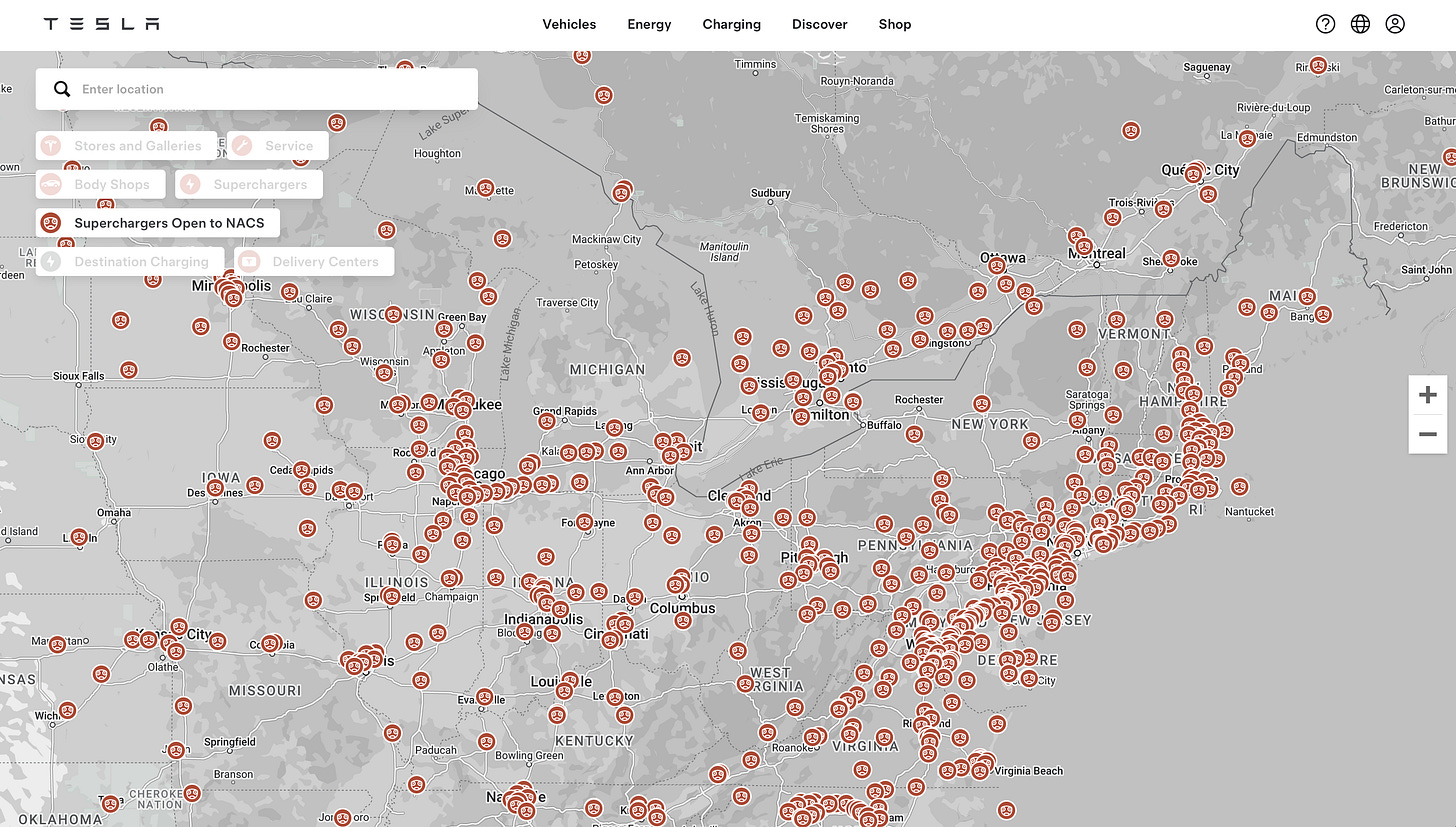 *If you are buying a Rivian or Ford, you want to filter the Tesla map to “Superchargers Open to NACS”. There are many.*
Not all Tesla Superchargers are NACS
Tesla Superchargers have three types: Tesla only, NACS, and Magic Dock. Here is the August 2024 state of Tesla Supercharger access:
- Tesla Superchargers without NACS or Magic Dock only work with Tesla vehicles. You can filter these out on the map to see them.
- Tesla Superchargers with NACS support only work with Tesla, Rivian and Ford. There are over 15,000 NACS Superchargers. If your vehicle is made by a different manufacturer, even if you have a NACS adapter, it will not charge your vehicle! Every auto manufacturer has announced Supercharger plans. Tesla has announced partnerships with GM, Volvo, Polestar, Nissan, and Mercedes-Benz – but support is not yet live. It might be next week, it might be next year!
- Tesla Superchargers with a Magic Dock work with any vehicle. There are less than 50 of these locations.
- Tesla Destination Chargers are slower, AC powered chargers – which means you will need a NACS to J1772 adapter (different from the NACS to CCS1 adapter used for DC fast charging – welcome to Dongletown, USA). Any vehicle can use Destination Chargers as long as they have the right adapter, but they are slow.
- The location of the charging port can be problematic at Tesla Superchargers. Older Tesla Superchargers have relatively short charging cables, since all Tesla vehicles have the charging port on the rear driver side (vehicles back into parking spots to charge). My Rivian R1T has the charging port at the front driver side. This means my charging port is on the opposite side of the vehicle, and I may have to block two chargers if I can’t reach my charging port.
By the 2026 or 2027 model year, most new vehicles will have NACS ports in the rear driver side location. Every manufacturer has agreed to standardize on this.
What’s all this about only charging to 80%?
There are a lot of myths and half-truths around EV charging that have become popularized. It’s all pretty complicated because it has to do with science and chemistry. The worries are very overblown.
Here is a scientific paper if you want to argue with people on the internet.
There are two main kinds of batteries in BEVs today. Lithium Nickel Manganese Cobalt Oxide (NMC) and Lithium Iron Phosphate (LFP, or LiFePO). NMC batteries use more rare earth metals, are more expensive, and smaller. LFP batteries are larger, heavier, and cheaper. There are newer battery technologies coming, but probably not for 10 years.
Batteries degrade over time, meaning they hold less charge – like how an iPhone starts dying by 8pm after 3 or 4 years. There are many factors that affect this.
LFP batteries are supposed to have very little degradation when charging to 100%, and can withstand 3,000-6,000 charge cycles before they lose noticeable performance. This would mean charging your vehicle from 0% to 100% every single day for 8–16 years!
NMC batteries will lose performance faster than LFP batteries when they are charged to the edges, meaning if you charge above 90% and run below 10% most of the time. When charging from 0 to 100%, your battery performance will fall within 450 charge cycles. If you keep charge between 20% and 80%, your performance will fall within 1,500 charge cycles.
While 450 charge cycles sounds low, 450 charge cycles from 0 to 100%, at 500km range for a full charge, is the equivalent of driving 225,000km. That’s around the lifecycle of an ICE vehicle’s engine. I don’t think anyone would expect an ICE vehicle to operate at peak performance after 225,000km (140,000 miles). Having said that, maintaining your battery between 20% and 80% will extend its capacity well into 450,000km – likely beyond the useful life of the vehicle.
Battery temperature also has a large impact on degradation, so try to pre-condition (warm up) your battery before fast charging as often as you can.
I’m personally not going to worry about it too much. If you want rules to follow, the basic guidelines most manufacturers, scientists, and strangers on the internet agree on are:
- Try to stay between 20% and 80% most of the time.
- Only plug in when you need to charge.
- Only charge to 100% when you have to do very long drives where charging opportunities may be difficult to find, such as rural road trips.
- Try not to let the battery fully die.
- Pre-condition before charging.
Okay but what about the winter?
Newer EVs have battery conditioning technology, which is fancy for it uses a heater to warm up the battery to increase battery performance. Batteries operate better, with less degradation (caused by crystals forming) when they are warm. If you are charging your car at home, you can have it automatically condition the battery before you leave!
But I heard the range tanks as soon as it gets cold outside?
EVs lose the same range as ICE vehicles.
Generally, EV range seems to drop 15% as temperatures go below freezing. If you have 500km of range, you can expect 425km of range below freezing. With a conditioned (warmed up) battery, or vehicles with a heat pump, you will see a much lower drop – if any.
As a point of comparison, ICE vehicles lose 15% in efficiency/range at -6°C, and drop more than 25% in efficiency/range for short trips where the engine has no time to warm up. You won’t see this discussed as a reason not to buy gas vehicles – yet you’re fueling up your car more often, and spending more on gas in the winter!
No, someone told me that EVs just stop working if it’s cold!
EVs have the same operating temperature range as ICE vehicles.
EVs will likely not operate at all below -27°C (I mean, I will also stop operating at -27°C. It’s never been that cold here.)
Generally, ICE vehicles will also stop operating at this temperature. The battery may not start the engine, and the oil may be too thick for the engine to function (and turning it on could cause permanent damage to the engine!).
If it is -27°C you should stay home.
But someone told me if the battery dies the vehicle will never work again and I’ll have to spend thousands of dollars to have it towed!
If your EV battery dies on the road, you have a few options:
- You can call service that offers “Vehicle to Vehicle” or “Vehicle to Load” (V2L charging. This can add 40km of range to get you to a charging station.
- You can tow your vehicle to a charging station.
- You can buy CAA. CAA Premier is $149/year, which includes 5 service calls per year. They provide emergency V2L charging, plus 320km of emergency towing once, and up to 200km of emergency towing 4 times. All for $149/year! Which is like, 5% of your fuel cost savings!
Any vehicle can receive V2L charging. Not all vehicles can provide power, though (Hyundai and Kia can). In the future, V2L will become a standard feature – which means other drivers will be able to give you a boost on the road in an emergency!
EV infrastructure has come a long way in the last five years. The issues early Tesla drivers faced aren’t really problems anymore.
But honestly, just take some of your fuel cost savings and buy CAA if you’re worried.
In older EV models, the battery completely draining did cause problems, since without a battery the vehicle can’t start the computers needed to regulate charging. But that was years ago. Most EVs now have a software-locked battery buffer (meaning, “100%” is actually 90%) and 12V battery to prevent this situation.
I thought AC/DC was a band?Why are there so many new terms?How do I talk to my angry uncle at Thanksgiving about fuel efficiency?
In ICE vehicles, you can generally use any gas pump at any gas station, and the main difference is paying for better fuel quality. In Canada, fuel efficiency is measured in L/100km (MPG in the US).
For EVs, you can use most electric charging stations, or a normal plug in anyone’s house. The main difference is going to be charging speed and how you pay. The terms are also different, as efficiency is measured in km per kilowatt hour (km/kWh).
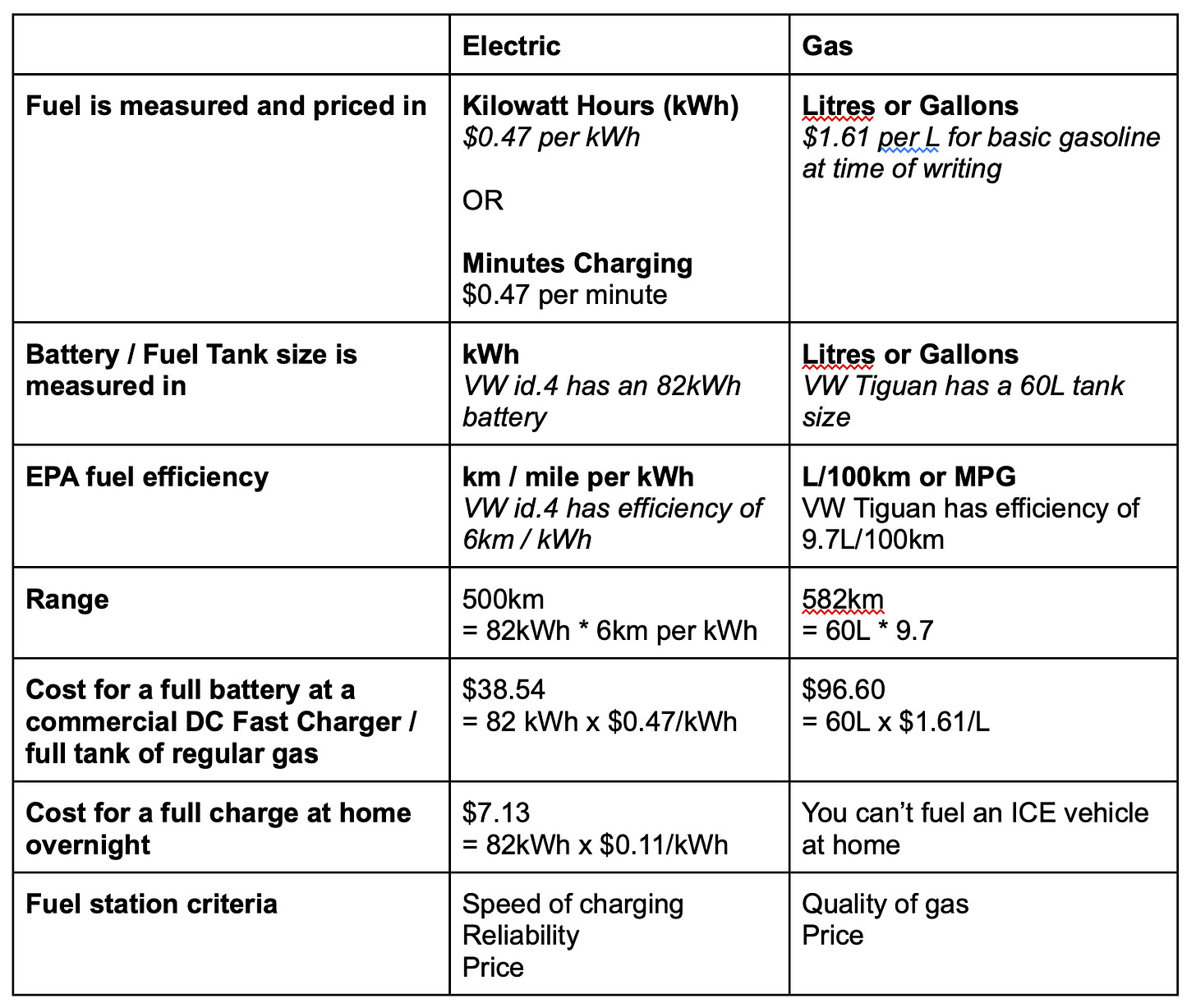 *Substack won’t let me embed tables, and Google won’t let me write in Canadian English, so here we are with a screenshot of Google Docs yelling at me. The American readers are saying “Finally!”*
Using the VW id.4 as an example:
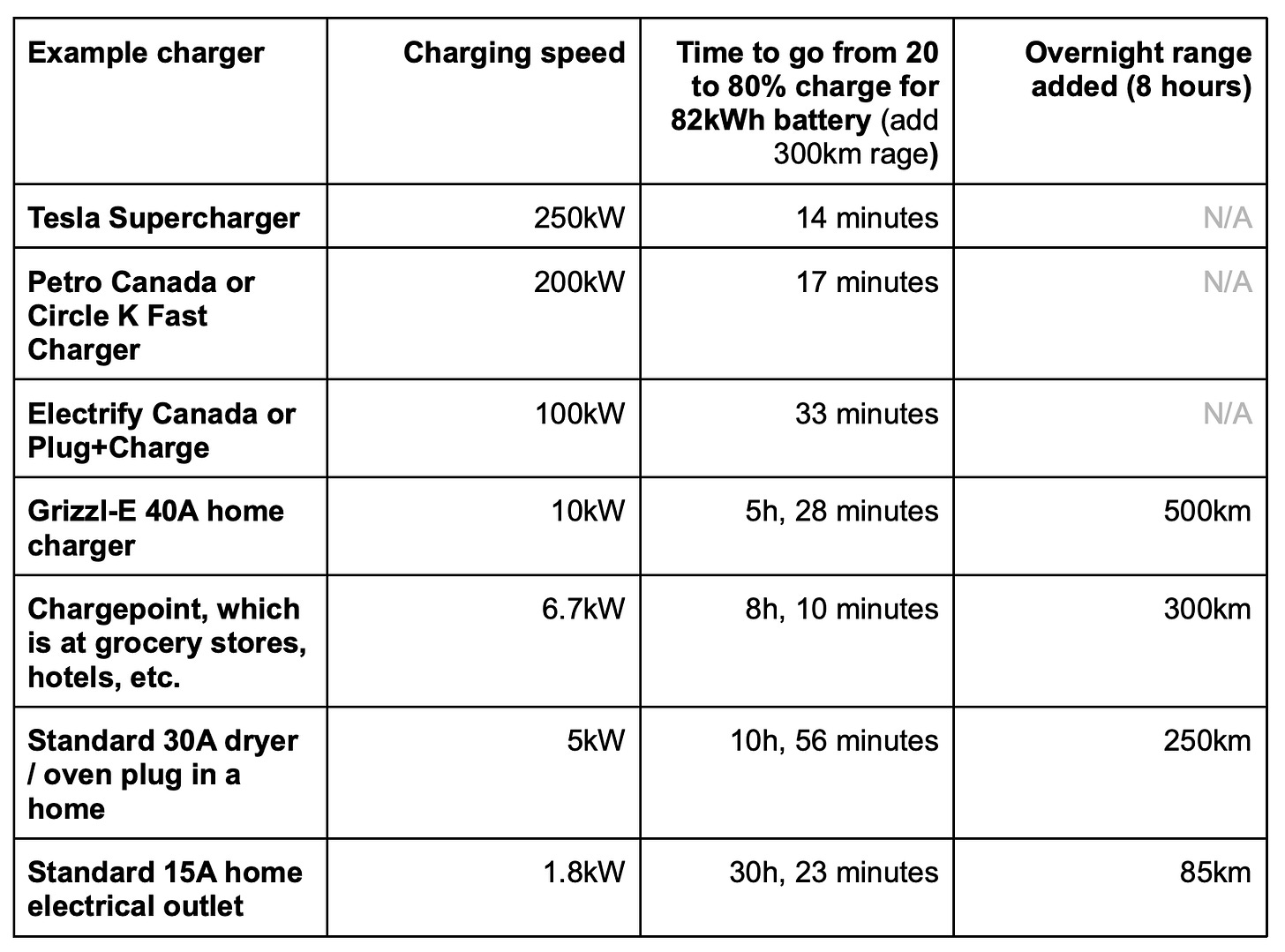 If you’re on the road, a fast charger will get you back to driving quickly. After 300km, or 3 hours of driving, you’re going to want to stop to buy a snack, use the washroom, and stretch your legs. By the time the car charges you’ll have done all of that!
If you are charging at home, a home charger from your vehicle manufacturer, or a generic brand like the Grizzl-E, will fully charge your vehicle overnight.
What’s this about regenerative braking? What is single pedal driving?
In a gas car, when you press down on the gas pedal you are accelerating the vehicle. If you let go of the gas pedal, the car will keep its momentum going until you hit the brake. When you press the brake, you are applying friction to the wheels to stop the vehicle. You have two pedals: one is go, one is stop.
Energy can’t be created or destroyed, only moved. When you brake a vehicle, you are moving energy. In traditional braking the energy moves in the form of heat generated by the brakes.
Regenerative Braking
EVs use a technology called regenerative braking. Instead of turning all of the energy from breaking into heat, some of that energy turns into electricity. Instead of using friction to stop the vehicle, your motor turns into a power generator that slows the vehicle’s momentum.
Single Pedal Driving
To increase how much power can be captured, EVs use an optional technique called single pedal driving to increase regenerative braking’s capacity to return energy. Single pedal driving can increase range by as much as 5% (~25km)!
It’s a really different driving experience.
With single pedal driving, the gas pedal acts more like a speed setting. If your foot isn’t on the accelerator, the car is stopped. If you press it down gently it will go 30km/h and stay there. If you press it down more it will go 50km/h and stay there. If you press it down firmly it will rapidly accelerate to 100km/h and stay there. If you don’t change the position of your foot it will keep that speed, as if cruise control is on. When you lift your foot off the pedal, the car will begin to brake until it stops.
Without pressing the brake.
If you test drive an EV this takes some getting used to. You can ask the car dealership to disable single pedal driving for your first test drive, so that the abrupt change in driving style doesn’t impact your view of the vehicle. Rivian, Ford, VW, and Tesla have buttery smooth implementations of single pedal driving, while Nissan and Honda feel like it’s your first day in driving school if you so much as wiggle your big toe.
In my week with the Rivian R1T I have grown to love single pedal driving. I have pressed the brake pedal maybe twice?
But this all sounds like a lot I have to learn. It’s easier to just buy a gas car. Why is an electric car worth changing my habits?
The sales rep at Ford literally asked me this before letting me see an electric car. My answer was “because of my personal value system, I’d like to do what I can to limit my personal impact on climate change.” And she, condescendingly, added “Wow, I didn’t know anyone actually cared about that!”
The benefits as a vehicle owner are clear:
- Lower maintenance costs
- Lower lifetime operating costs
- Quieter, smoother drive
- Fun, zippy drive
- Fewer things can break down in the vehicle that need repair
- You can power an electric kitchen (if your vehicle has 120V/15A outlets)
- You can power electric power tools (if your vehicle has 240V/30A outlets)
- You can power your house (V2L support required)
- Green benefits like lower insurance costs and HOV lane access
- You get to do a good thing for the planet and model climate leadership to provide hope to future generations that maybe we are actually willing to solve this problem. We can have clean air – no emissions! We can have clean energy (if that’s what powers your community).
The downsides are:
- Higher upfront costs
- Charging infrastructure is in flux
- Anxiety about learning how to charge and manage a battery
- Waiting 15 minutes at a charger when you’re on a road trip and you’re stopping for lunch anyway? Learning new words?
EVs are so expensive! Are used EVs a good option?
Yes! I bought a used Rivian R1T from Shift Motors in Oakville.
I went with used for a few reasons:
- It was a 2024 model, and only had 4,300km on it. It still had the stickers on the screens and the accessories in their original packaging. It was basically new.
- Rivian will transfer/honour the original warranty – most manufacturers do this, more below.
- The Carfax record was clean (but that doesn’t always mean anything, and Rivian hasn’t integrated their service records into Carfax yet).
- Compared to a new model with the same specs, I saved $30,000!
But isn’t a used EV really risky? I heard the batteries don’t last!
Used EVs are substantially less risky than used ICE vehicles for the simple reason that there are fewer components that can break, and fewer components to maintain. I have never purchased a used vehicle before, so I did a lot of research on this to become comfortable with buying a used EV.
The main risk with a used EV is battery degradation.
First, the batteries are under warranty for something like 5 to 8 years. If the manufacturer’s warranty ports over to a new owner, then this is a non-issue.
Yes – EV batteries may degrade after years depending how they are charged (see above).
You can, and should, ask a used car dealership to run battery diagnostics for you – you may even be able to do it yourself within the vehicle (Google “view battery health vehicle model” for instructions). You will also see accurate range estimates on the vehicle screen. To figure out max range, it’s simple math – divide the estimated range by the %.
- If the vehicle has 30% battery left, and says 160km of range, divide 160 by 0.30.
- 130/0.33 = 533km range at 100% charge!
Reduce your risk with a trust but verify approach:
- Ask for a battery health report: if they don’t provide this, don’t buy the vehicle. Do your own math on the range based on the vehicle’s estimates.
- Ask for a CarFax report: if they don’t provide this, don’t buy the vehicle.
- Don’t trust the CarFax report: explicitly ask if the vehicle has any unreported damage, any repair history, any service, recalls, or parts replaced. Ask this over email so it is in writing. A friend bought a used ICE vehicle recently and they only disclosed an accident after he signed the contract, when he went to pick up the vehicle. You can imagine how that went.
- Ask if the manufacturer’s warranty is still valid and transfers to a second owner. I called Rivian prior to purchase and provided them with the VIN to verify the warranty was still valid and would be transfer. You have to call to transfer the warranty, it is not automatic! This is true for Rivian, Tesla, Ford, VW, etc.
- Test everything: door seals, sound systems, automatic locks, hard acceleration, hard braking, all the built-in cameras. You may only be able to do this on a second test drive, when you’re serious about that specific vehicle.
I bought my R1T at Shift Motors. They exceeded my expectations for customer service – far better than what I had at any of the manufacturer dealerships. My sales rep at Shift Motors, Simeon, was so transparent in the process that I felt very comfortable going with the used vehicle.
If you want to try a variety of electric vehicles, I would strongly recommend heading to Shift Motors in Oakville. Since they are an EV only dealership, and you can try all of the makes/models in one location.
I have no relationship with Shift Motors, I’m sharing this because it was an exceptionally great experience and I feel good customer service and honest sales should be rewarded.
What electric vehicles are out there? What did you try? What would you recommend?
As you might imagine, I researched all of them and I tried a lot of them. I wanted at least 500km of range, which led me to try the vehicles below.
Prices below are for the extended range battery models as of August 2024, in Canadian dollars, with Ontario pricing, and do not include dealer discounts, tax, or Federal ($5,000) or Provincial rebates:
- Volkswagen id.4 Pro – $55,728: I loved it. It’s the same size as a Tiguan, with a luxury quality interior. The screen/UI setup was the best of any EV I tried. The drive was fun and sporty. It had the quietest cabin inside. It gets over 500km of range. The only knock on it is the lack of Tesla Supercharger integration – VW has promised it in 2025? Maybe? If you mostly drive locally and can charge at home, with occasional road trips, this is the one I would buy. Do not buy a pre-2024 VW id.4 – they changed the architecture substantially. 2024 has great reviews, the prior years are poor. VW currently has 0.99% financing, in this economy?!
- Ford Mustang Mach-E Extended Range – $61,528: I had to go to two Ford dealerships. The first wouldn’t even talk to me. At the second dealership, I had to convince them that I liked EVs more than ICE vehicles to even get a test drive. No wonder they have dozens of them sitting on the lot. The drive was great, the interior was great, the exterior was great. I’m not a huge fan of the weird tall screen, but I’m sure you’d get used to that. Ford vehicles are Tesla Supercharger compatible today. If I didn’t buy a truck, I would have purchased the Mach-E (due to my road trip I need the Tesla Supercharger compatibility, otherwise the VW id.4 is superior in my opinion). Reviews of the Mach-E have been stellar from day one. I did not try the F-150 Lightning but they are well reviewed and you can often get very good deals on them if you go to a rural dealership (less than $65,000).
- Nissan Ariya Evolve+ – $64,846: It’s fine. It’s big, the size of a Murano. The drive is stiff. The single pedal driving was terrible. The staff had no knowledge about the vehicle at all. For the price, get a VW or Ford.
- Tesla Model Y Long Range – $63,990: I did not want to buy a Tesla, because Elon. When I went to try it, the interior look was much better than I expected based on what I’ve heard online. However, the interior cabin feel is very poor for the price point. It’s echoey, the sound is tinny, and the road noise is high. The build quality isn’t great. I think if it's the only EV you try, you won’t notice that as much – but going from Volkswagen to Tesla, you can immediately feel the quality drop. I personally wouldn’t buy it.
- Honda Prologue EX – $62,995: The 2024/2025 Honda Prologue is a beautiful car with a luxury interior, built on a horrible platform. I didn’t know this before driving it, but the Prologue uses the same base platform as the Chevy Blazer (which was recalled for bricking vehicles) and the Cadillac Lyriq (which has a stop sale on it currently). This is disappointing because the Prologue had an amazing 80’s futuristic style outside and luxury interior inside. I loved the look of the car. The 2026 model year is going to be a brand new, Honda engineered platform (which will have its own first year issues). I would avoid Honda until 2027 models.
- Kia EV6 Wind – $55,995 / EV9 Wind $62,995 : Kia’s EVs are all mostly sold out for the next year – they have great reviews – and when I went to try the EV6 and EV9, they were not available at the dealership. Waterloo and Kitchener Kia trade which location has them each week. I’ve seen them on the road and love the look.
- Hyundai Kona – $49,177: I don’t personally like the look of Hyundai’s current generation. The range of the Kona is a bit lower (420km), and combined with the lack of Tesla Supercharger support, it knocked them off my list. The Ioniq 5 has longer range (488km) but it’s more expensive at $57,576 to start and quite a bit smaller. Hyundai and Kia use the same platform, so pick the one you like the look of better.
- Volvo EX40 – $63,389: When I started this process I thought I was going to get an EX40, since I previously had (and loved) the XC40. Volvo has promised Tesla Supercharger access – but Elon fired that whole team, so it’s not available yet. I didn’t end up trying it, as they raised the prices so much – by the time you spec things out with AWD, sunroof, etc. the EX40 costs the same as a Rivian R1S. The VW id.4 is $30,000 less with the same specs – and comparable build quality, interior finishes, and range. Volvo is also now owned by Geely, a Chinese automaker. Sorry Volvo, VW wins this round.
- Rivian R1T and R1S – $115,000+: I clearly loved the R1T the most, since that is the vehicle I purchased. Unless you need to do Camping Truck Stuff™, most people would be better off with an R1S – the Escalade-sized model. However, this is a >$100,000 Canadian vehicle, so most people are better of not buying one. Rivian has more affordable models coming: the R2 and R3 coming out in 2026 and 2027 (the R3 is the coolest looking car I’ve seen in a long time). Rivian currently has $9,000 off new 2024 models. 2025 (“Gen 2”) has an all new architecture and is the first model year with Rivian’s in-house designed motors.
I didn’t try, but researched:
- GM/Chevy/Cadillac: Nobody would talk to me at Cadillac. The Chevy Blazer has been recalled as a lemon. The Cadillac Lyric has since been put on a stop sale due to system failures. GM’s entire EV line-up post-Bolt appears to be built on a bad foundation. They just fired 1,000 people from their software team. I don’t know who is running GM’s EV division but they aren’t executing well.
- Polestar: A luxury/performance spin-out from Volvo, I didn’t try them – the price point was similar to Rivian, and Rivian offered a better fit for my life of adventure. They have great reviews if you have a lot of money!
- Audi: I didn’t try the Q5 E-Tron because it’s literally a rebadged VW id.4 for $25,000 more with a worse UI. There is currently no benefit to buying Audi over VW other than a logo in this generation.
- Subaru: 359km range. Sad.
- Mercedes: 354km range? For $150,000? Seriously?
- Lexus: 354km range? Seriously?
- Jaguar: 370km range? lol
- Toyota: They still don’t sell battery electric vehicles, only hybrids. (They claim to make a BEV but you can’t actually buy it).
- Mazda: They still don’t sell battery electric vehicles, only hybrids (“coming soon”)
- Jeep: They still don’t sell battery electric vehicles, only hybrids (“coming soon”)
- Land Rover: They still don’t sell battery electric vehicles, only hybrids (“coming soon”)
- BMW: I am not a BMW person and I do not like their angry looking aesthetic or the reputation of their drivers, but their battery vehicles like the iX are well reviewed and have great range, for a lot of money. If you like BMW and have a BMW budget, definitely look at them.
The tl;dr is if you’re looking to buy an EV I would suggest trying:
- 2024+ Volkswagen id.4 – best quality, price, range combination (VW has 0.99% financing right now!).
- Any year Ford Mustang Mach-E – great option for road trips with Tesla access, and very sporty look (Ford has employee pricing discounts right now but you have to fight the dealership to actually get it).
- Any year Ford F-105 Lighting – best for Actual Truck Stuff™ (on road and on the job site).
- Any year Kia EV9 – comparatively affordable 3 row SUV, if you can find one.
- Any year Rivian R1T or R1S – best for Camping Truck Stuff™ (off road), and best luxury SUV, if you can afford one (they have $9,000 off 2024s right now). They have more affordable compact SUV models coming out in 2026.
- Any year Volvo, Polestar, and BMW for luxury brands.
 ### Additional thoughts on Rivian, CarPlay, and cars as computers:
I want to preface this section by saying I am happy with my decision to buy a Rivian. I went with Rivian for the smart storage design, exceptional battery life, fit and finish, the sound system, and most important for me – the kitchen that can go in the gear tunnel.
Rivian’s vehicle management software – controlling the truck itself – is exceptionally great. It’s responsive. It’s customizable. The level of detail is great. The UI is lovely and easy to use.
But when it comes to maps, music, texting, phone calls, and voice control – it is very poor.
Every auto maker except Tesla, GM, and Rivian, have CarPlay and Android Auto support. I am an Apple customer and CarPlay great. I’ve used it for years, I had it in my old Volvo XC40. I swore I would never buy a vehicle without it – but I did. And it’s as terrible as I feared.
I have since purchased a $150 CarPlay screen to add CarPlay, because using the vehicle without it is tediously painful. If you’re coming from bluetooth you won’t notice these things, but if you’re used to CarPlay:
- I can’t use Waze, Google Maps, or Apple Maps. In the vehicle I have to use Rivian Maps, which suck at routing – they directed me incorrectly three times when I was going to pick up my camping tent in Burlington. The lane guidance is awful. It doesn’t call roads or highways by the proper name, instead using obscure map names that aren’t on road signs.
- The Rivian Maps are not up to date on the Canadian charging ecosystem, so I can’t see Circle K or Park+Charge DC fast chargers on the map, or get directions there. This has the consequence of limiting fast charging, because Rivian won’t let you manually pre-condition the battery – it pre-conditions when you set a fast charger as a destination. (I now lie and say I’m going to Tesla.)
- I can’t use a voice assistant to listen to or respond to text messages. Today, there is zero support for text messaging or invoking Siri via Bluetooth anywhere in the system. In any bluetooth only car I’ve driven, you can still invoke Siri with the steering wheel buttons. Not so in Rivian.
- I can’t use voice commands to change Apple Music songs within the Rivian-built Apple Music app. Voice commands are powered by Alexa, and only work with limited services. Seriously, to search for a song in Apple Music you have to use an on screen keyboard while you are driving. They thought that was acceptable to ship?
- I can’t access music if the vehicle doesn’t have a cellular connection.
- I tried calling a pizza place to order for pick-up, but I could not tap the phone number in Rivian Maps to call them. I had to pull into a parking lot and manually dial the phone number into my phone.
This also means for Rivian’s software team is distracted:
- Instead of improving vehicle quality of life, their engineering resources are spread out replicating functions built into CarPlay and Android Auto.
- International expansion is going to be terribly difficult when it comes to localization given how poor the maps experience is in Canada.
Why are they doing this? Simple – it looks better on their books to have subscription review.
Rivian just announced Connect+, a $150/year subscription to get access to music streaming and maps. BMW famously received flak for charging a subscription for heated seats. Everything is a subscription now because that’s what the stock market values.
The problem here is that auto manufacturers are choosing to provide an inferior experience to nickel-and-dime customers. Over 5 years Rivian will make $750 from my subscription. I would rather just pay $1,500 at time of purchase for a CarPlay “Premium Infotainment” system upgrade. But my one-time purchase doesn’t look as good on their balance sheet as subscription revenue.
And sure, I could use bluetooth to stream my music to the vehicle like it’s 2008 to avoid paying their subscription – but the experience is terrible and it doesn’t have to be that way.
Rivian’s CEO has communicated that this is a software integration problem, which is bullshit, as CarPlay is integrated to various degrees in most cars on the market using a “punch-through” UI. Of course Apple wants to control the whole thing, that’s what Apple does. But Rivian doesn’t have to agree to those terms to implement CarPlay (no one else has). It would be more honest for Rivian to tell their customers it's because they want to increase shareholder value by creating subscription revenue, but that’s bad for PR.
Given that GM, famous for saying they will never support CarPlay because they could build better software themselves, just fired 1,000 engineers – I imagine GM will backtrack and add CarPlay again soon. I look forward to Rivian doing the same as they enter the broader consumer market. When consumers can compare the R3 to a Volkswagen id.4, Rivian is going to have a very hard time winning customers – at least, based on today’s broken sales organization (a story for another day) and poor media, maps, and phone experience.
It’s a very sour point in an otherwise exceptional vehicle. If they had CarPlay this would be a 10/10 vehicle.