
The American Breakfast Sandwich
Pickles may make an appearance
Probably Worth Sharing is a reader supported publication. If you enjoy this content, please consider a paid subscription or share this post with a friend!
What makes a good, classic American breakfast sandwich?
I didn’t expect this to be the question I needed to answer on my vacation, but the question found me.
It all started in Toronto.
My friend Jin Sol had told me about Gold Standard, a walk-up breakfast sandwich place in Roncesvalles, Toronto. I happened to be in Toronto, so I stopped at Gold Standard before heading to the airport on Friday.
I got Gold Standard’s classic breakfast sandwich: an English muffin, soft scrambled eggs, bacon, hot sauce, and plot twist – pickles. It was incredible, and the best I ate on my trip.
I had two.
The next day, Saturday, I was at Disneyland with Mike and Billy – who I hadn’t seen in four years! Normally at Disney we would snack throughout the day at the park, but with my Invisalign we decided that sit-down restaurants would be easier, opting for a bigger breakfast and dinner. At Carnation Café we found a breakfast sandwich: brioche bun, folded scrambled eggs, American cheese, bacon.
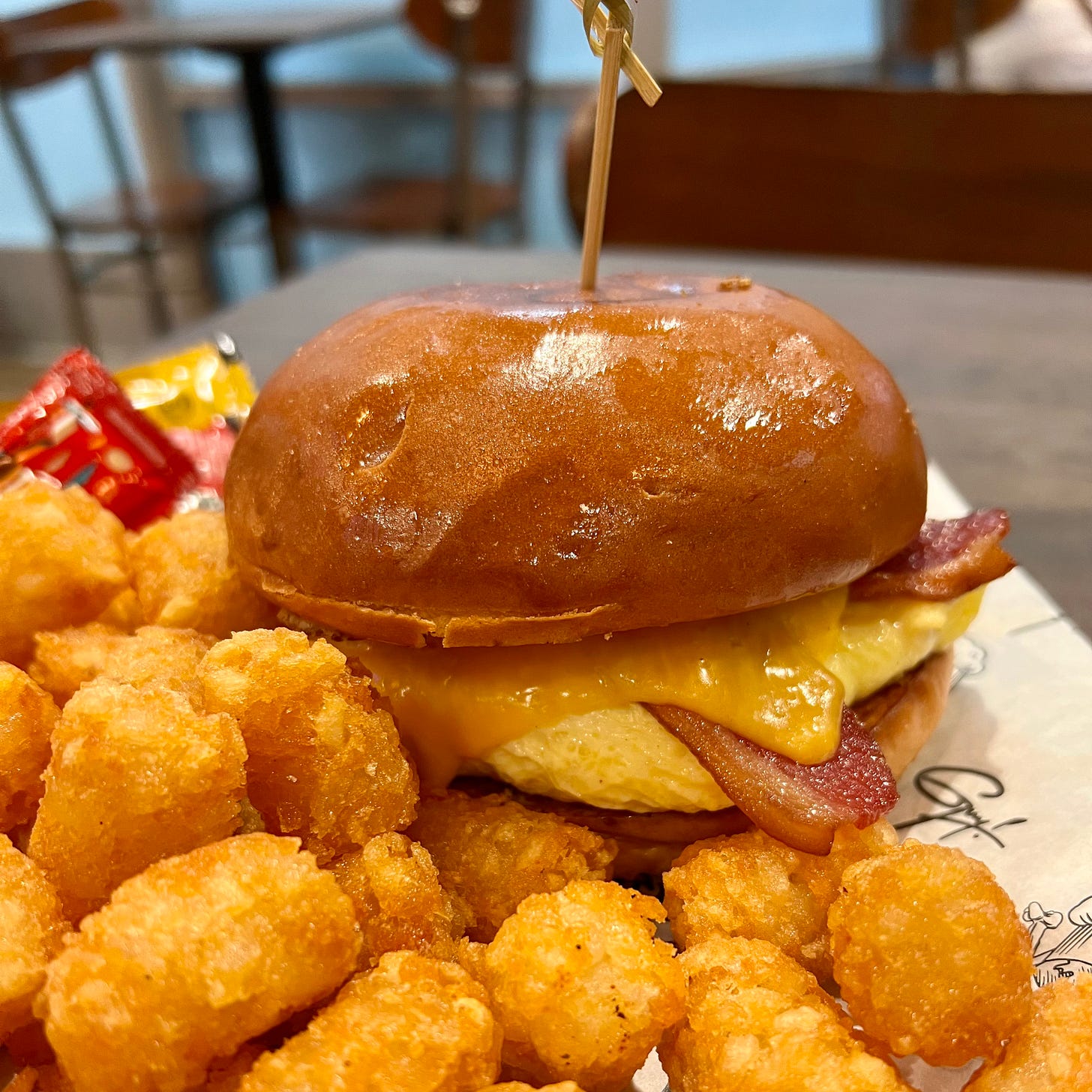 *While the photo looks good, Guy Fieri’s sandwich was nothing to write home about.*
On Sunday, at Burbank Airport, I had an hour to kill before my flight to San Francisco. It turns out Burbank’s aiport is as small as Kitchener’s and security took all of four minutes, leaving me with enough time to eat and do my tooth brushing routine in a public bathroom, which I have to tell you is not fun.
Guy Fieri’s name is on a restaurant there, so naturally I got a breakfast sandwich. It was very similar to Disneyland’s: a brioche bun, overcooked folded scrambled eggs, American cheese, and bacon. Served with lukewarm tater tots that I swear to you came out of freezer bag from Costco.
At this point I joked on Instagram that I should find a breakfast sandwich every day for the rest of my trip, mediocrity be damned.
Later that day I met up with my friends Janice and Miles, in San Francisco’s Inner Sunset district. Janice, not knowing about my journey so far, asked if I wanted “really good fish and chips” or “a really good breakfast sandwich” for dinner.
The answer was obvious.
We went to Devil’s Teeth Baking Company, a bakery, where we got both a classic and a special breakfast sandwich (and several cookies to share.) Both breakfast sandwiches are made with biscuits and soft scrambled eggs. The Classic with American cheese and bacon; The Special with pepperjack, avocado, and lemon garlic aioli. The Special was a bit much – too fatty. I enjoyed the biscuit, but it quickly fell apart. This is knife-and-fork food, not eat-on-the-sidewalk friendly.
On Monday there were no breakfast sandwiches to be had. I was running late and the Mariott was terrible – no iron, no room service, no breakfast sandwich.
On Tuesday I went to Alameda to see Christina and Paul, my foodie friends who I told all about my breakfast sandwich tour. Christina made me a breakfast sandwich with folded scrambled eggs with chives, thinly sliced tomato, aged cheddar, and a buttered, toasted English muffin (quite good). Paul intended to make me one on Wednesday, but when I had walked into downtown Alameda for groceries and coffee… I found breakfast sandwiches at The Beanery. Clearly I needed this for the evaluation: a toasted English muffin, a bacon-inside-egg-patty (I think microwaved), and cheese. It was not my favourite.
Heading home Wednesday night, at the San Francisco Airport, I debated getting a breakfast sandwich at Lark Creek Grill (Terminal 2) – but it was nothing new. California has gone all in on the brioche bun and bacon. At this point I was tired of sad bacon and overcooked eggs.
Perhaps with an English muffin and breakfast sausage they would have won me over.
Instead I got a burger.
So what even is an American breakfast sandwich?
The classic American breakfast sandwich is a spectrum. I most closely associate it with the McDonald’s Egg McMuffin: an English muffin, ham, egg, and cheese. Though, we can all agree the superior Egg McMuffin is the sausage variation.
I can support the brioche buns of California’s breakfast sandwiches, but they veer closely into New York’s iconic Bacon, Egg, and Cheddar (BEC) – which is made with soft scrambled eggs, cheddar, hot sauce, and a kaiser bun.
The lines get blurry as you get into different breads. My local favourite, The Yeti Cafe’s Pregnant Cowgirl is technically a sandwich you eat at breakfast, but with the addition of avocado, tomato, and garlic aioli on a bagel, is it a Breakfast Sandwich™?
(No, but you should still get one with half salad, half hash browns).
One step further… the tortilla. Is a breakfast burrito a sandwich? I say no. It’s a burrito.
And no, you cannot have a keto breakfast sandwich. PUT THE LETTUCE DOWN OR MAKE SSAM INSTEAD!
So here I am going to discuss each component: bread, egg, cheese, meat, and accouterments, and further below is my recipe for my ideal classic American breakfast sandwich.
Bread
English Muffins
I’m partial to the English muffin. They offer substantial benefits and few downsides. A good English muffin is soft, you can bite through it without squishing out the eggs. They also crisp nicely, the best part of an English muffin is the slightly-over toasted crispy edge. English muffins hold onto things, whether it’s butter, pickles, eggs, or cheese, through the power of nooks and crannies. A well made English muffin has a deep, almost malty flavour.
The downside? Good English muffins are hard to find (you should make them, they are easy – recipe below). Grocery store English muffins are often dry, crumbly, and filled with dough conditioners:
Enriched Wheat Flour (may Contain Barley), Water, Yeast, Wheat Gluten, Soybean And/or Canola Oil, Salt, Sugar, Calcium Propionate, Fumaric Acid, Vegetable Mono- And Diglycerides. May Contain Potassium Sorbate, Sorbic Acid. Topping: Corn Meal, Corn And/or Rice Flour.
Compared to:
Flour, milk, butter, sugar, salt, yeast, semolina flour
Brioche Buns
I understand why restaurants go for brioche, and why you might at home. Good brioche buns are easier to find, you can get them at most grocery stores. For restaurants, they already have them for burgers, so it’s one less inventory item. They are soft, so you can bite through them easily. But I find a few challenges:
- they are much larger so it can be more difficult to shove the whole breakfast sandwich in your mouth.
- They cut and toast evenly, so you don’t get those occasional crispy moments of bliss you do with an English muffin.
- They are buttery, which is great – except a breakfast sandwich is already quite fatty with egg and meat.
Biscuits
While I very much enjoyed the biscuit at Devil’s Teeth, between the biscuit and the soft scramble the sandwich had no structure or texture – it may as well have been biscuits and gravy. It is not for eating with hands. Good biscuits are hard to find and hard to make. Marci assures me that cheddar and chive scones make for a great breakfast sandwich base, but I find them equally fraglie.
Bagels, kaisers, and sandwich bread
Yes, I have made a breakfast sandwich with a bagel and a fried egg. Yes, I get the Pregnant Cowgirl at the Yeti often. But no, they are not Breakfast Sandwiches™.
Kaisers immediately turn the sandwich into a BEC, and feel more like a lunch affair.
Sandwich bread makes this more of a grilled cheese with eggs. I cannot abide by it.
So, for me, it has to be an English muffin. I will accept brioche. Everything else is a novelty. And it must be a closed faced sandwich, because otherwise you are venturing into eggs Benedict territory.
Eggs
The eggs can be made many ways:
- In a mold, unbroken, like at McDonalds
- A scramble with the meat in it already, like at The Beanery
- A fried egg, like at The Yeti
- A firm, folded scramble like at Disney, Guy Fieri’s restaurant, and Christina’s home-made sandwich – potentially with herbs
- A soft scramble, like at Gold Standard and Devil’s Teeth
The McDonald’s style steamed egg has that hard-boiled egg taste from the overcooked yolk, and I don’t love the eating experience of distinct whites/yolks. I think fried eggs are delicious, but a fried egg has too much risk of the yolk popping into a mess down the front of your shirt in a sandwich (unless its cooked hard, but then the taste changes). They also don’t fit nicely into an English muffin. Folded scrambled eggs can be good, but they risk being overcooked and rubbery. They do travel well. The soft scramble, with the right English muffin and cheese to give it structure, is the optimal egg for me, but they can be messy to eat on the go.
If you’re making it at home, pick your favourite. I like a soft scramble.
Cheese
There are many approaches to cheese:
- American cheese which has various quality. Kraft Singles are heavily processed with 31 ingredients, Kraft Extra Cheddar only has 22 but omits the worst offenders like carrageenan.
- Cheddar slices, which are more natural but don’t melt effectively
- Cheddar you slice yourself, such as using a bougie aged cheddar
- Other melty cheese, like pepperjack and Colby
- Goat cheese, if you are an animal
For me I want flavour and meltability, so I do use American cheese here. I wish there was a less processed version easily available, but there is not – so my recommendation is Kraft Extra Cheddar (the Singles are loaded with garbage ingredients)
If you want to do more work (I don’t), Serious Eats has a great explanation on the science of why processed cheese melts, and how to turn bougie cheese into melty cheese. See also this episode of Planet Money on American cheese vaults.
I’m also of the opinion that there should be two slices – for taste and to hold the eggs together. I believe the cheese should be on the bottom English muffin and on top of the eggs. Some recipes have you melt the cheese on the breakfast sausage (as you would a cheeseburger), but these recipes are wrong and they make sloppy sandwiches.
The best bite of cheese on an Egg McMuffin is the half melted cheese you pull off the wrapper.
The Meat
Bacon, sausage, or ham? It’s a personal choice.
You can’t go wrong with bacon, but I strongly prefer breakfast sausage. I do not want ham.
Grocery store breakfast sausage patties are not great – they almost all have corn syrup – so if you’re going to use breakfast sausage you should make your own (it takes minutes! MINUTES!)
Here’s what’s in Johnsonville:
Pork, Water, Sugars (corn Syrup, Dextrose), Salt, Monosodium Glutamate, Lemon Juice Powder (corn Syrup And Lemon Juice Solids, Natural Flavours), Natural Flavours, Modified Vinegar.
Here’s what’s in mine (recipe below):
Pork, Spices
Breakfast sausage is all about the herb mix and crispy exterior. I’ve tried dozens of recipes over the years to land on what I like. I prefer dried herbs, instead of fresh – they can be turned into a powder for more even distribution. Fennel and sage are required. I prefer thyme, but you could go with rosemary or oregano instead. I also add a tiny amount of nutmeg (I did not like the recipes with cloves), but you can leave it out. You need to add some sugar for the caramelized exterior. I’m using cane sugar, you can use brown sugar for a bit more flavour. I find maple syrup overtakes everything else – moving into McGriddle territory, better for side sausages instead of a sandwich.
Accouterments
A breakfast sandwich does not need accents, but they can give it some needed punchiness and balnce. The salty, fatty taste of a McDonald’s Egg Muffin is delightful – but a bit of sweet, heatt, and acid can really make the sandwich amazing.
I think the problem with most breakfast sandwich additions is that they add more creamy, fatty sameness instead of contrast. While “More is More” is very American, I don’t think it makes a better sandwich:
- While I love a garlic aioli, I think in the simplicity of a breakfast sandwich is becomes overwhelming and becomes the flavour.
- The same for avocado, there is enough fattiness between the eggs and meat. I think it works in a sandwich like The Pregnant Cowgirl because the tomato balances it, but the avocado is the star – not the egg. You can get the cowgirl without an egg.
When it comes to balancing flavours:
- I think tomatoes follow the same path as the fatty additions – they become the story. While they add a nice acid, they are also juicy and slide around, making the sandwich difficult to eat. Good tomatoes are hard to get year-round, and now it’s basically a BLT. (Sorry Christina.)
- Herbs – chives are popular. I think they can work with bacon but compete with sausage’s herbiness (sage, fennel, thyme, paprika). Your herbiness might vary.
- Gold Standard added two bread and butter pickles, which I found to be very surprising but delightful – a bit of sweetness and acidity. I would not go dill pickle, they will dominate the sandwich.
- Gold Standard also added a bit of a vinegar hot sauce, which I enjoyed.
- Bon Appétit suggests adding hot honey, which I tried, but I find the honey gets a bit lost, it’s sticky on the hands, and the chilli flake heat is a bit stale compared to the bright punch of vinegar hot sauce. If you want honey flavour, use the honey in the sausage instead.
For me, it’s a vinegar hot sauce and pickles. You may disagree, but I want you to try it once before you do.
Layering
The optimal layering for me is as follows:
- Toasted, English muffin half
- Pickles
- Sausage
- Cheese
- Hot sauce
- Egg
- Cheese
- Toasted, English muffin half
This helps the cheese act like a binder, keeping the soft scrambled eggs together. The hot sauce creates little pockets of spice in the eggs, so each bite is a slightly different adventure. The eggs are at the bottom so if they squash out they compress instead of cascading down the side of the sandwich.
I don’t think the English muffin needs to be buttered, there’s enough fattiness already.
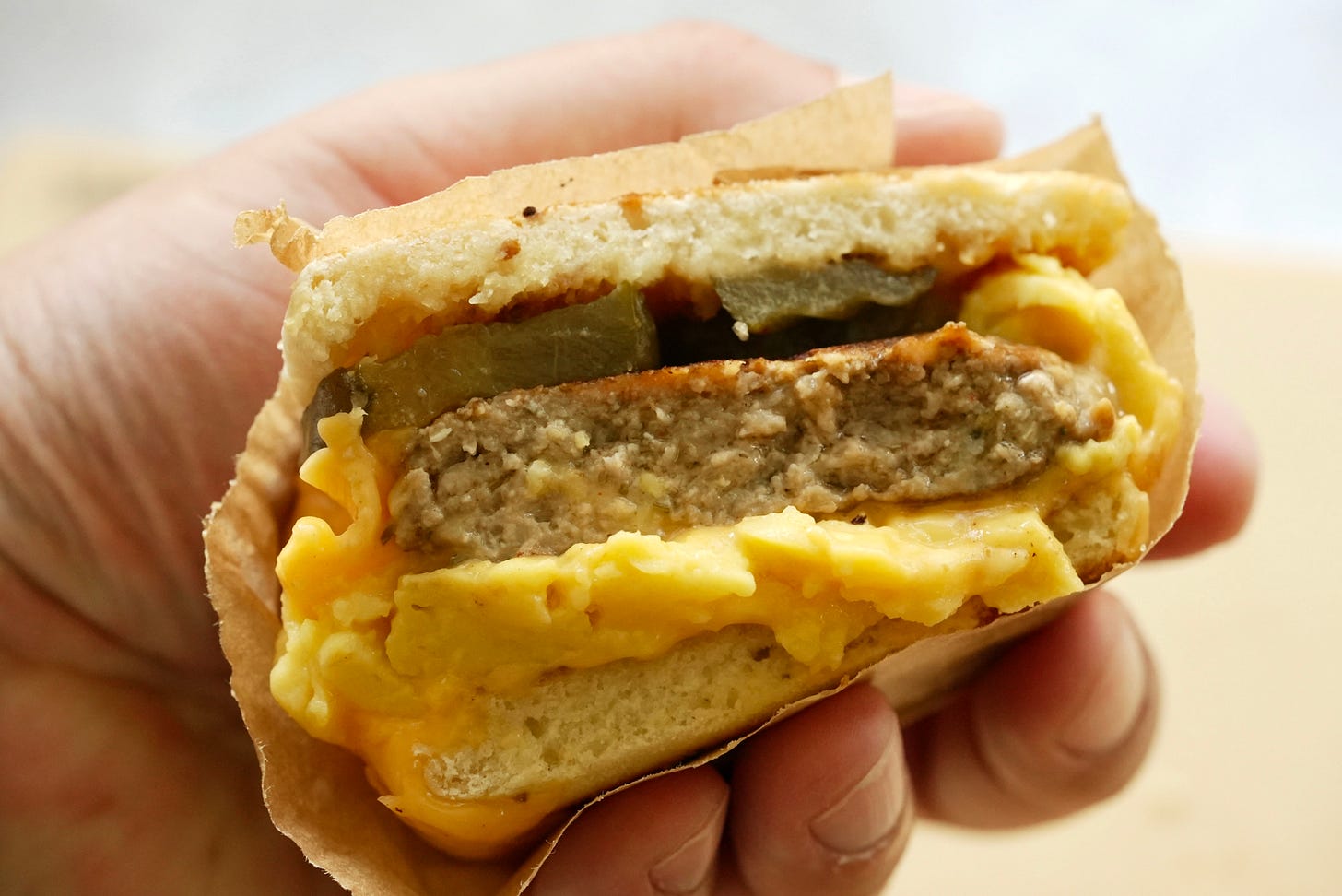 # Marko’s breakfast sandwich
Sure, you can ignore everything about this recipe and just make a breakfast sandwich the way you like it. Throw on pickles and hot sauce and call it a day. Use a bagel for all I care. But I think you should try making it this way just once and you will be so happy that you do.
The “harder” components here – English muffins and breakfast sausage – are actually very easy. They can be made ahead of time and frozen individually. They reheat/cook in minutes, so you can go from freezer to breakfast sandwich in 10 minutes: faster than waiting at McDonalds.
English muffins
Grocery store English muffins are dense, dry, sad, and crumbly. They’re generally stale because they are filled with preservatives and dough conditioners. I make my own. You can make your own. They’re very easy and they freeze really well.
This recipe makes 16 English muffins. Please use a scale.
Ingredients
- 400g | 1-3/4 cups milk, warm (30°–40°c | 86°–104°F)
- 45g | 3 tablespoons unsalted butter, softened
- 5g | 1-1/2 teaspoons salt
- 25g | 2 tablespoons sugar
- 50g | 1 large egg, lightly beaten
- 540g | 4 1/2 cups all purpose flour
- 5g | 2 teaspoons active dry yeast
- 1/2 cup semolina flour (for dusting)
Method
You can make this by hand or in a mixer, but it’s a very soft/sticky dough, so it’s a lot easier in a mixer.
Proof the yeast: Heat up the milk until it is around body temperature – warm, not hot – and add the yeast. Stir and set aside. While you can add the yeast directly to the dry mix, it will distribute more evenly and activate more quickly if it’s allowed to dissolve in the milk first.
In a mixer: Using the paddle attachment (not the dough hook), add everything except the semolina and mix on medium speed for 5 minutes until a stretchy, soft, tacky-but-not-sticky dough forms. Shape into a rough ball and cover the bowl.
By hand: Add everything except the semolina into a bowl. Mix until a rough dough forms, transfer to the counter, and knead for 7–10 minutes until the dough soft, stretchy, and tacky-but-not-sticky. It will be very sticky at first and transform through kneading. Avoid adding more flour and use your bench scraper for leverage. Transfer to a clean bowl and cover.
First proof: Allow to sit, covered, for 1–2 at room temperature until doubled in size.
Divide and second proof:
Cut a sheet of parchment paper into 16 @ 4” squares. Add the semolina flour to a small bowl and set aside.
Divide the dough into 16 pieces, around 65g | 1/4 cup each. Shape each piece into a tight ball by pinching the sides towards the bottom. Toss each ball into the semolina flour, then use your hands (or the flat bottom of a glass) to squish each ball into a 3-1/2” wide circle. You’ll have a better finished muffin if you push/flatten vs pull/stretch. Place each flattened circle on a 4” parchment square, then place on a baking sheet or on the counter (you might need 2 baking sheets). Once complete, cover the English muffins with another inverted baking sheet or a piece of parchment paper.
Proof for another 20 minutes: They will rise only slightly, getting “puffy” but not growing very tall.
Cook in a skillet or on a griddle: You can use any pan or skillet. I used two pans, and cooked these in two batches (4 per pan). Place the skillet on medium-low heat, add the English muffin to the pan, sliding it off the parchment paper. Cook for 7–10 minutes, then flip, and cook for another 7–10 minutes (15–20 minutes total).
You’re looking for a golden brown exterior, spongy texture, and if you have a digital thermometer an internal temperature of 200°F. I found it helpful to spin the English muffins 180 degrees after 3 minutes to even out the browning.
Allow to cool, separate with a fork: Allow to cool fully before separating (if you separate them immediately the texture will become very gummy). To separate, insert the tines of a fork into the English muffin side, going all the way around the outside. Then go back around and pry up with the fork. Using a fork helps ensure all the nooks and crannies stay in place. If you slice with a knife you’ll get a smoother, bread-like texture.
Freeze: You can freeze the separated English muffins and go from freezer-to-toaster (or frying pan, or broiler). Make sure you separate them before freezing, or else you will have to thaw, then separate, then toast, and that’s just too much work.
Soft scrambled eggs
In A Super Upsetting Cookbook About Sandwiches (highly recommended if only for the arguments he has with his editor in the footnotes, but the recipes are great too), Tyler Kord introduces a technique to make the best eggs for a sandwich, but putting them in a blender first.
Blending eggs breaks the proteins in the whites and yolks thoroughly, so as the eggs cook the proteins recombine into a network that holds water, instead of allowing it to evaporate.
Constant stirring also ensures the proteins form a mesh network instead of a lattice. Low heat keeps the flavour closer to custard than the cooked egg taste of McDonalds or an American omelette.
It’s a bit of extra work, but you’re going to have to wash a bowl and fork, so you might as well wash your immersion blender (or magic bullet, or vitamix). If you hate the idea on principle, I challenge you to try it just once.
You will think there is cream in your eggs, but there is not.
Ingredients
- 4 Eggs
- 1 tsp butter
- Pinch of salt
Method
Add your eggs and a pinch of salt into a cup, put your immersion blender into the cup, and blend until very smooth. For a larger batch do this in a blender.
Alternatively, beat very well with a fork.
Heat a small frying pan on medium-low heat. Add the butter, once it melts add the eggs, stirring very often (almost constantly) to encourage small curds to form. Remove from the heat once no more liquid is visible.
This is the best recipe for scrambled eggs in the world.
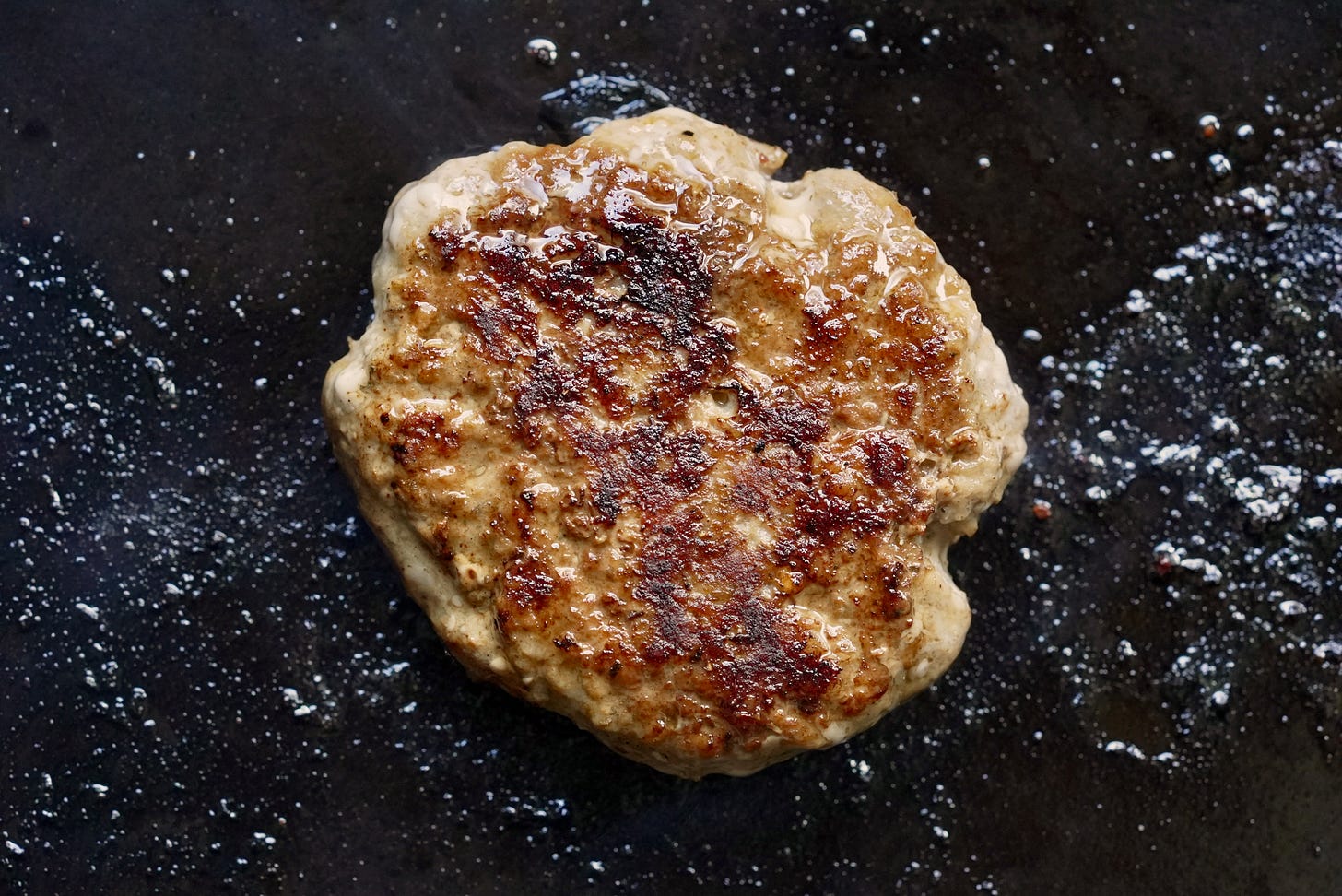 ## Breakfast Sausage
Make these ahead of time (make a double or triple batch) and keep them in the freezer. Because they are so thin they will cook up in 8–10 minutes from frozen, so you are always minutes away from a delicious breakfast sandwich. I just made a triple batch (24!) to keep in the freezer. It was super fast and easy!
Don’t skip the nutmeg – it might seem odd, but it really rounds out the flavour with some warmth. If you don’t have nutmeg you could use allspice or cloves, but cloves are very strong and you just need a tiny pinch.
Ingredients
- 500g | 1lb ground pork
- 1-1/2 tsp dried sage
- 1-1/2 tsp dried thyme
- 1-1/2 tsp fennel seeds
- 1-1/2 tsp salt
- 5 peppercorns
- 2 tsp cane sugar (or honey, or maple)
- 1/2 tsp garlic powder
- 1/2 tsp red pepper flakes
- 1/4 tsp smoked paprika
- 1/8 tsp ground nutmeg (grate from whole on a microplane!)
Method
Line a 1/4 baking sheet with a piece of parchment paper. If doubling/tripling the recipe, have additional parchment ready.
Add the sage, thyme, fennel seeds, peppercorns, and salt into a pestle and mortar, or to a spice grinder, and turn it into a powder. Add the sugar, garlic powder, red pepper flakes, smoked paprika, and nutmeg, and stir to combine.
In a medium bowl, add the pork and spices. Use your hands to mix to combine, mixing very well – at least 30 seconds – to ensure the spices are evenly distributed. Mix this well, which will help the fat bind the meat better (instead of crumbling). This will help when you form the sausage patties.
Divide into 8 equal portions (1/4c | 63g each), roll into balls, then squish into a 3.5”–4” patty (they will shrink and thicken as they cook), 1/8–1/4” thick, and place on the parchment lined baking sheet. If you are making a lot, add a sheet of parchment between each layer of patties.
To cook immediately
Heat a skillet or griddle on medium-high heat. Once hot, add the sausage patties and cook 4 minutes per side until caramelized on the outside and cooked through the centre.
To freeze for later
Place the baking sheet in the freezer and freeze until solid, around 1 hour. Cut the parchment paper around each patty, then stack in a freezer-safe container (using the parchment to keep them separated, otherwise they will all stick together).
Follow the cooking directions above, cooking directly from frozen. Since they are so thin they will cook very quickly, but may need an additional minute or two.
Cold Oven Bacon
If you are making bacon instead, the best way to make bacon is in a cold oven. There is no mess, no splattering, no work. You have a lot of control over how the bacon finishes. It’s easy.
Ingredients
- Bacon
Method
Layer your bacon, overlapping slightly (this helps slow down the bacon contracting as it loses water), in a 13x9 baking pan – such as a lasagna pan.
Place the bacon in the middle of a cold, turned off oven. Set the temperature to 425. Set a timer for 20 minutes.
Generally by the time the oven preheats, or shortly after, the bacon is ready.
Transfer the bacon to paper towel or a clean kitchen towel, and separate the pieces while they are still warm (they will adhere together otherwise). Pour the bacon fat into a heat-proof glass container and then store in the fridge to use later.
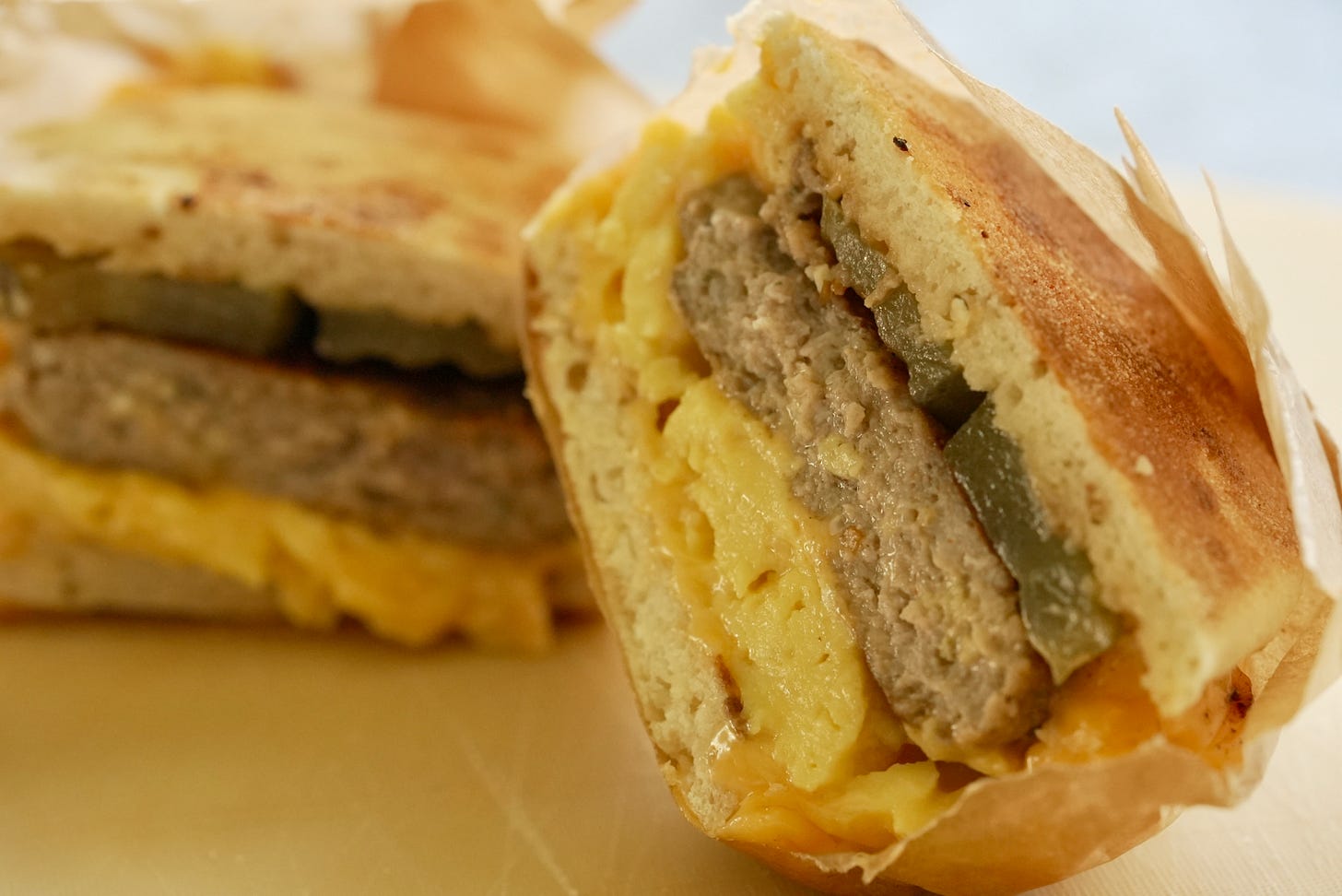 ## Breakfast Sandwich
Makes one sandwich, but you should make, like… at least two.
Ingredients:
- 1 English muffin
- 2 Eggs
- 1 tsp butter
- 1 breakfast sausage patty (or 2 slices of bacon)
- 2 slices of American cheese
- 3–4 thinly sliced bread & butter pickles
- Vinegar hot sauce (to taste)
Notes: you could easily replace the pickles and hot sauce with kimchi for a similar sweet/sour/hot punch that would be delicious.
Method:
Cook the sausage and toast the muffin: Set one skillet on medium-high heat. When hot, add your breakfast sausage and cook for 4 minutes on one side. Flip, then add your English muffins (nooks-and-crannies side down) to the same pan to get crispy. Remove both after another 4 minutes (when the sausage is cooked through and the English muffin is toasted).
At the same time, make the eggs: Set a small skillet over medium-low heat with 1 tsp of butter. Add your eggs to a cup and blend with an immersion blender (or beat very well with a fork). Pour the beat eggs into the pan once the butter has melted. Stir constantly with a flexible spatula, ensuring a small curd forms. Once there is no more liquid visible, form into a 3.5” wide shape, and cook for another 15–30 seconds to firm up the eggs.
Add hot sauce to taste, then set a piece of cheese on top of the eggs.
Assemble: Set a piece of cheese on the bottom English muffin. Transfer your eggs and set on the cheese. The eggs should have cheese above and below them. Add the sausage on top, then pickles, then the remaining English muffin half.
Wrap: The pro-move is to wrap the breakfast sandwich in parchment paper or wax paper, then optionally slice it in half with a serrated/bread knife. Wrapping it will help use any residual heat to melt the remaining unmelted cheese and squish the sandwich down. It’s a much better eating experience and helps keep everything contained.
Serve immediately.